3-3-2020 Primary Local Ballot Measures

There are 2 local propositions on the ballot in Pinole this primary- Measure R from the West Contra Costa Unified School District, a bond measure to fund school renovations in WCCUSD; and Measure J from Contra Costa county, a sales tax increase of 1/2 cent for 30 years to fund various transportation projects.

I support Measure R and Measure J.

The reason why I support Measure R is simple. Pinole has benefited disproportionately from the last school bond measure to pass- it funded the construction of the new Pinole Valley High School,at double the expected cost. Those funds were not available to go to the last projects on the reconstruction list, which just happened to be concentrated in Richmond, in historically disadvantaged areas. Without Measure R, those projects will continue to not be completed, and if Proposition 13 passes, WCCUSD will be less able to access funds from it. As a resident of Pinole, we owe the rest of the district the chance to do better than we did.

Measure J has a good balance of transit measures across the county. While I would like to see a BART extension towards Hercules prioritized, failing that the measures taken in Measure J are a good mitigation step. It would increase funding for roadway repairs across the county (which Pinole certainly needs). It would also dedicate a significant amount of money ($250 million) to improving bus service frequency and lowering cost of use in West County, which is key to having buses be accepted as a transit alternative (https://ccta.net/wp-content/uploads/2019/10/CCTA_TEP_Draft24_final3_102319.pdf, the 2020 Transportation Expenditure Plan, page 22).

3-3-2020 Primary- Statewide Ballot Measures

Proposition 13- School rebuilding bonds. Yes.

One of the core problems in California’s post Proposition 13 (1978) system is that some local school systems can raise bonds to rebuild their schools much more easily than others. This Proposition 13 grants an increased share of cost to the state for worse-off districts, and prioritizes those projects higher than they currently are through linked legislation. (see https://vig.cdn.sos.ca.gov/2020/primary/pdf/prop13-title-summ-analysis.pdf, page 14). In addition, the state is running out of money to fund any new school bond projects (ibid, page 12), and those projects are of substantial, long-term importance.

My Commitments

I have agreed to abide by the city of Pinole’s Local Campaign Contribution Limits, and California’s Code of Fair Campaign Practices.

The Local Campaign Contribution Limits caps the amount I can raise from any single person at $500 dollars, from any political committee at $1000 dollars, and the overall amount I can raise at $12,000 dollars.

The Code of Fair Campaign Practices is worth quoting in full. It says-

CODE OF FAIR CAMPAIGN PRACTICES

There are basic principles of decency, honesty, and fair play which every candidate for public office in the State of California has a moral obligation to observe and uphold in order that, after vigorously contested but fairly conducted campaigns, our citizens may exercise their constitutional right to a free and untrammeled choice and the will of the people may be fully and clearly expressed on the issues.

THEREFORE:

(1) I SHALL CONDUCT my campaign openly and publicly, discussing the issues as I see them, presenting my record and policies with sincerity and frankness, and criticizing without fear or favor the record and policies of my opponents or political parties that merit this criticism.

(2) I SHALL NOT USE OR PERMIT the use of character defamation, whispering campaigns, libel, slander, or scurrilous attacks on any candidate or his or her personal or family life.

(3) I SHALL NOT USE OR PERMIT any appeal to negative prejudice based on a candidate’s actual or perceived race, religious creed, color, national origin, ancestry, physical disability, mental disability, medical condition, marital status, age, sexual orientation, sex, including gender identity, or any other characteristic set forth in Section 12940 of the Government Code, or association with another person who has any of the actual or perceived characteristics set forth in Section 12940 of the Government Code.

(4) I SHALL NOT USE OR PERMIT any dishonest or unethical practice that tends to corrupt or undermine our American system of free elections, or that hampers or prevents the full and free expression of the will of the voters including acts intended to hinder or prevent any eligible person from registering to vote, enrolling to vote, or voting.

(5) I SHALL NOT coerce election help or campaign contributions for myself or for any other candidate from my employees.

(6) I SHALL IMMEDIATELY AND PUBLICLY REPUDIATE support deriving from any individual or group that resorts, on behalf of my candidacy or in opposition to that of my opponent, to the methods and tactics that I condemn. I shall accept responsibility to take firm action against any subordinate who violates any provision of this code or the laws governing elections.

(7) I SHALL DEFEND AND UPHOLD the right of every qualified American voter to full and equal participation in the electoral process.

I, the undersigned, candidate for election to public office in the State of California or treasurer or chairperson of a committee making any independent expenditures, hereby voluntarily endorse, subscribe to, and solemnly pledge myself to conduct my campaign in accordance with the above principles and practices.

That means I will be honest about what I see as the issues facing Pinole, that I will criticize policies that deserve criticism without fear or favor. I will not use attacks on other candidate’s character by any means, and I will repudiate any support or endorsement I have received from anyone else if they do so. I will not appeal to prejudice or bigotry (which I would never do in any case- I abhor bigotry of all kinds). I will not undertake any dishonest or unethical practice to corrupt the elections or stop people from voting (unlike many actions of the Republican party over the last decade). I won’t coerce contributions or help from anyone, not just my employees (since I don’t have any). I will repudiate any support I have received from a person or group if they do any of those things. And I will fight to make sure that everyone who is allowed to vote can vote.

My Qualifications

I think a good city councilor above all else needs to be able to Listen. If you can’t listen to your constituents, you can’t understand their concerns. If you can’t listen to your fellow council-members, you don’t know what their goals and concerns are, or what their objections might be to your goals and concerns. If there’s any one thing I’ve learned from working as a home healthcare aide, it’s how to listen. Listening isn’t just about hearing the words that are said, though that’s definitely important. Body language, tone, which words in particular are used, and what is not said are all important parts of listening as well.

Second, you need to be Persuasive. You need to be able to persuade the electorate to be elected at all, of course, but you also need to be able to persuade your fellow Council-members and anyone you’re working with on the various boards you’re assigned to. If you can’t persuade people, you can be a great listener and problem solver and have exactly the right vision- but you won’t be able to use those strengths to accomplish your vision. It’s difficult to prove that you’re persuasive in the abstract, so I’ll refer to my speech on the Library at the May 15th meeting (video, go to 1:09 for the core of the argument).

Third, you need to be a good problem solver. This is relatively broad- you need to be open-minded, to have access to the broadest possible range of ideas, be good at analyzing things, so you can get rid of the ideas that don’t work, and be able to implement your chosen solution. You also need to be able to learn things quickly. Some of these attributes I’ll only be able to demonstrate over time, through actions- but I’ve already demonstrated them in one instance. I went to the University of Chicago and graduated with a BA in Political Science with general honors. I did that by learning ideas from a broad range of sources- ancient writers, modern ones, activists, and through my work in a community non-profit; synthesizing them together in various different ways as the situation required, and implementing my understanding of those ideas through writing and action.

Fourth, you need to be Dedicated. I have demonstrated and will continue to demonstrate this dedication by attending city council meetings, and urge my fellow candidates to join me. Being on the city council is a significant ongoing time requirement. You are, at a minimum going to be spending ten hours a month at city council meetings, and at least that much again on various committees and regional boards. Based on my discussions with city staff, being on the City Council, if you don’t interact with the community at all outside of meetings, is a 40-hour workweek at below minimum wage levels. If elected, my work as a home healthcare aide allows me schedule flexibility to meet the needs of the city, above and beyond the minimum requirement. As I’ve stated in my platform, I intend to do outreach on social media and via flyers to make the city’s information more accessible to the general public- both before and after the election.

Finally, you need to have a vision. Your job as a city council member isn’t to do nuts and bolts implementation of city policy- that’s the city staff’s job. Your job is to provide direction. My vision for Pinole is a city where there’s a thriving community that is engaged with its government, which in turn provides the services and spaces to help the community thrive.

About Me

I’ve been living in Pinole since 2011, helping with my mother’s daylily business for all of that time and working as a licensed home healthcare aide since 2016. For a while, I was disengaged from politics- but Bernie Sanders’ campaign in 2016 got me back into political action. I joined the Pinole Progressive Alliance in 2017, and have been working with them to try and get the library running at full hours. After going to all but one of the city council meetings since May, I saw that there was a marked disconnect between Pinole’s city government and the community, that there was significant division within the community, and that there were not really any community gathering spaces for working-age adults in Pinole. After talking with city staff, I realized the long-term threats to Pinole’s financial stability. Without better engagement and communication between city government and the community, Pinole will decline. But working together, we can renew Pinole.

My Platform

My Platform

Securing Pinole’s financial future

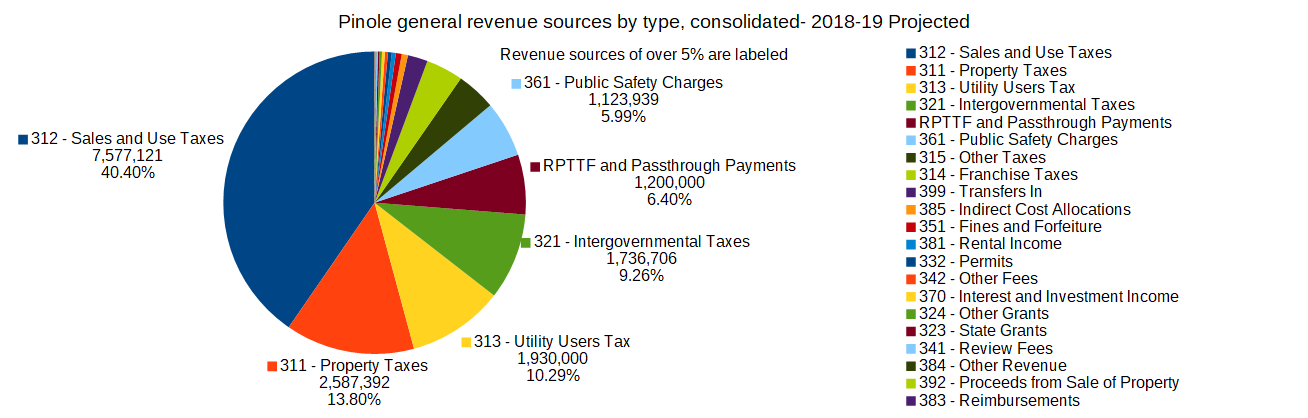
I’m running because I think Pinole needs to secure it’s financial future. While Pinole’s budget is in balance now, there are future threats which will need to be addressed. Since propositions 13 and 218 sharply limit how much revenue Pinole can raise from property taxes, the city has relied on Sales tax as the city’s largest revenue source (by far, over 40% of unbound revenue) (budget, pages B-1 and B-2), and the Utility User Tax (UUT) as a significant source of income (10.29% of this year’s unbound revenue, as noted on page B-1). When times are good, like they are now, this isn’t a huge problem. An influx of customers keeps most of the chains open and sales tax revenues high. But when they go bad, the city doesn’t have many counter-cyclical revenue sources. Furthermore, in the city’s own 5-year projection for the general fund, it anticipates significant deficits every single year from 2019 onwards, ranging from $397,603 in the 2019-20 budget year to -$1,539,485 in the 2022-23 budget year, primarily due to marked increases in benefits and insurance costs (City budget, B-10).

In the long term, the big box mall store model is going out of favor, and as the mega-chains collapse (like Toys R Us and OSH), the tenants that replace them might not provide sales tax revenue at all. Finally, the utility user tax (UUT) has been declining over time with the phasing out of landlines, and could potentially drop precipitously if there’s widespread solar installation. I think the city should investigate new counter-cyclical revenue sources.

That said, if the UUT fails the city will immediately face a 1.9 million dollar deficit. I will be campaigning for the UUT measure on this fall’s ballot, Measure C, and urge all voters in Pinole to vote for it. But right now, people are disinclined to vote for it because they don’t see the concrete benefits the government provides. That’s why I’m working on:

Reconnecting Pinole with its government

People feel out of touch with the city government, and vice versa. Even though there’s lots of information that the public can access, people don’t necessarily know that. The city’s website redesign might mitigate some of this, but the city needs to do more direct outreach via social media, mailings and postings at popular community gathering places. I will be doing some of this outreach as part of my campaign, and will continue to do so if elected.

City documents aren’t always easy to understand. Take the city’s budget. The budget proper, while it goes to some lengths to explain items to the public, has no graphs in it whatsoever. You can watch the video of the presentation on the budget which does have graphs, but I wouldn’t call that accessible. I made some graphs from the city’s budget, which you can find here. In addition, I will write a detailed as well as top-level analysis of this year’s budget as I understand it in another blog post. You can find the top-level analysis here.

Finally, most working-age adults cannot attend Tuesday night council meetings to give their input on the city’s agenda items after Citizens to be Heard. I am going to ask the public what meeting times would be easiest to attend, so it would be easier for members of the public to give their input. If the Council is unwilling to change meeting times, at the very least it should have Citizens to be Heard immediately after closed session.

But even if all of these things are done, there’s not necessarily concrete things that the government can point to within the operating budget. That’s why I think we need to work towards having concrete things to point to- like having the library be open every day of the week, and in the longer term reopening the Pinole Valley Fire Station.

Renewing the Library and reopening the Pinole Valley Fire Station

I think one of the major challenges we face as a community is that we lack community institutions for families and non-senior adults. Certainly, there’s the senior center for seniors, and the youth center for youth. But for working-age adults and families as a whole, there isn’t a natural community gathering place.

I think the Library can and should become that place. There’s already a large space separate from the library proper that is used for community events, and it could easily be converted into a community center outright. The problem is that the city of Pinole hasn’t funded maintenance of the library for years, and so it’s only open every other weekday. I would work to have the city take control of the library, fund it so that it can be open every weekday, and create a community gathering space there. This would strengthen the community as well as the library.

Doing this would make it clear that government can bring benefits to the community. On the basis of this, it would be possible to start working towards more ambitious projects, like reopening the Pinole Valley Fire Station. The city has never had the necessary revenue stream to keep that station open, but in rush hour it’s a public safety risk having the only station be on the other side of the high school. While the city is limited in what revenue sources it can seek by state law, I believe that keeping a fire station open is a classic community benefit for a parcel tax levy. I would prefer to adjust the property tax rate directly, but Proposition 13 bars that. Of course right now, the community is divided enough that even existing tax measures draw opposition when they are up for renewal.

Bringing Pinole together

And so, finally, I think we need to come together as a community. That starts with my listening to as many people as I can reach from all walks of life- from the Labor Council to the Rotary Club, from the Police Department to the Pinole Progressive Alliance. I will listen to all sides so that I can represent everyone, and so that I can understand everyone’s perspectives. I will be open minded, because it’s the right thing to do, and because representing the community is impossible with a closed mind. If you can’t understand other people’s perspectives, you can’t represent them properly.

Why I am Running

Pinole can be better- a city where there’s a thriving community that’s engaged with its government, which in turn provides the services and spaces to help the community thrive. But by default, this will not happen. Inertia in the structures of government and the challenges people face in their everyday lives has lead to disengagement with government, which will lead to a backlash against government revenue sources, which will lead to fewer services and on in a cycle of decline.

I plan to break that cycle at the root, by getting information on what the government does out to the community. The Pinole Library would be an ideal space for that, but it’s only open every other weekday because the city doesn’t pay for its maintenance. I think the city should fully fund the library’s maintenance so it can act as the heart of the community once again.

2018 California Primary Recommendations

2018 California Primary Recommendations

Propositions

Proposition 68- Yes. This propositon creates $4 billion in new statewide bond debt to fund parks, climate resilience and water quality. The text of the proposition (http://voterguide.sos.ca.gov/pdf/text-proposed-laws.pdf) has controls to ensure limited funds are spent on administrative and planning costs, and explicitly directs funds to disadvantaged communities to rehabilitate and build new parks there (disadvantaged being defined as “a community with a median household income less than 80 percent of the statewide average.” (Propositions Proposed Laws full text, page 5).

Proposition 69- Yes. It amends the California constitution to ensure that the new funds raised by the gas tax hike can’t be redirected later to a non-transportation purpose by adding them (and vehicle license fee revenues) to the Public Transportation Account (ibid, pages 26-7). While ordinarily I’m not a fan of amending the California constitution to restrict budget flexibility, I think it’s fair that revenues from taxes on cars and car use be dedicated to roadway maintenance and other public transportation goals.

Proposition 70- No. It’s clearly a transparent attempt by Republicans to block allocation of funds generated by the cap and trade program- there’s no good reason to raise the requirement for spending the funds from 50%+1 to a 2/3rds super-majority unless you want to block as much as possible. Back when the budget had to be passed by a 2/3rds supermajority, CA failed to pass a budget on time quite frequently because the GOP minority was able to use their power to block the budget.

Proposition 71- Yes. It requires that ballot measures only take effect 5 days after the election is certified (ibid, page 28). What that means in practice is that late delivered postal and provisional votes count, rather than being basically irrelevant.

Proposition 72- Yes. I dislike property tax carveouts, but the carveout for home water capture systems is going to be quite minor (as the legislative analysis notes- http://voterguide.sos.ca.gov/propositions/72/analysis.htm) in terms of budget impact, and we want to encourage water conservation.

RM3- Yes. We need massive transit infrastructure upgrades throughout the Bay Area, and while RM3 won’t fund all of them it will fund several major projects- linking BART into Santa Clara, more BART cars, and more locally finally fixing the deathtrap 680-4 interchange (http://sfelections.sfgov.org/sites/default/files/Documents/RM_3_Ballot_Description.pdf, page 3). Furthermore, it does so in a sustainable way by increasing bridge tolls, rather than yet another bond measure.

Measure P (Pinole)- No. While I’ve listened to and considered the arguments from the Pro and Anti-P sides, ultimately the fact that it was scheduled for a primary election when there would be a smaller electorate voting on it decides me against it. Regardless of whether the funds were available in Pinole’s elections fund, it was fundamentally unnecessary to hold this measure at this election, as the only council member who would be affected by the success or failure of the measure has stated she will not run for re-election this November regardless of the outcome of the measure.

Candidates- Statewide

Governor- John Chiang. While I’d be fine voting for Gavin Newsom in the general election, his attempt to stack the election to get a GOP opponent rather than a fellow Democrat is ill-advised and reeks of personal ambition. Even if he can trivially defeat a GOP opponent, their presence at the top of the ballot will increase GOP turnout, possibly creating problems in other elections. So then my choice is between the other Democrats. Limiting my choice to those Democrats who have a plausible chance of winning a spot in the general (I.e, at least 5% average support polled May, as noted here- https://realclearpolitics.com/epolls/2018/governor/ca/california_governor_open_primary-6299.html), the two remaining Democrats are John Chiang and Antonio Villaraigosa. While I like Villaragiosa’s experience as mayor of LA, I don’t like his moderate positions or his pro-charter policies. By contrast, John Chiang has clearly progressive policies on issues ranging from the MeToo movement to single-payer health care, and has the necessary fiscal chops from his years as treasurer and comptroller to practically implement those policies.

Lt Governor- Gayle McLaughlin. I know Gayle. She was the mayor of Richmond when it cut the murder rate by actually addressing the root causes of gun violence (https://www.motherjones.com/politics/2014/06/richmond-california-murder-rate-gun-death/), raised the minimum wage and implemented rent control. She and the RPA broke the power Chevron had over that town (https://gayleforcalifornia.org/bio/). Furthermore, her priorities as Lt. Governor are exactly what we need to focus on as a state, from Medicare-for-All to reforming Prop 13 to building affordable housing (https://drive.google.com/file/d/0B6nt8KJI22zsWThweTRzRnpDM2s/view).

Secretary of State- Reuben Major. While I approve of Alex Padilla’s efforts to expand voting access through automatic voter registration and pre-registration of teens, I think the risk of voting machines being hacked deserves a higher priority than just “implementing existing law”. Reuben’s big issue is forcing a transfer back to paper ballots (http://www.rubenmajor.com), which is critical since there is not yet an electronic voting system that cannot be hacked (for reference, https://www.coursera.org/learn/digital-democracy for an entire college-level course on why electronic voting systems are fundamentally insecure).

Controller- Betty Yee. Mary Lou Finley doesn’t have enough information avaliable on her positions or record for me to determine that she’d be a better candidate, and Betty Yee says she’ll push for comprehensive tax reform and affordable housing (https://bettyyee.com/about-betty/issues-that-matter/).

Treasurer- Vivek Viswanathan. He wants to fix the unfunded pension crisis, supports expanding medi-cal accessibility and working towards medicare for all, and to update Proposition 13. These are all policy positions I think are worth pursuing.

Attorney General- Dave Jones. His support for rehabilitation in communities, fair housing in all communities for the homeless and holding law enforcement accountable (https://www.davejones2018.com/cms/wp-content/uploads/2018/05/Media-What-Dave-Jones-will-do-as-AG.pdf) wins my vote.

Insurance Commissioner- Ricardo Lara. He wrote SB 562, the bill that actually tried to implement single-payer in California. On the strength of that he gets my vote.

State Superintendent of Public Instruction- Tony Thurmond. He has the practical experience from serving on the West Contra Costa Unified School Board for 6 years, and his policy goals match up with what I think the state should be focusing on in education, from accountability for charters to improved physical and mental healthcare for students (https://www.tonythurmond.com/tonys-plan).

US Senate- Kevin De Leon. While Dianne Feinstein would certainly be better than any of the Republican candidates, she’s taken several votes which I feel were actively harmful to California. From passing fast-track authority for the TPP, to diverting water from the Delta to the central valley farmers in a prelude to the twin tunnels project (https://calwatchdog.com/2016/12/08/white-house-knocks-sen-feinsteins-ca-water-compromise/), to failing to support Medicare for All, Dianne Feinstein is insufficiently liberal for California in the 21st century. Kevin De Leon, by contrast, has stated his support for Medicare for All, and if he can make it to the general election ballot he’ll have kept the GOP out of the senate race. Based on polling (https://ballotpedia.org/United_States_Senate_election_in_California_(June_5,_2018_top-two_primary)), he’s the only non-Feinstein Democratic candidate in this race who can do that.

Candidates- Regional

CA Assembly 15- Jovanka Beckles. Like Gayle, Jovanka’s work in Richmond as a city council member and member of the RPA gets her a fair amount of credit in my eyes. Her work to ban the box in Richmond shows that she’ll fight for criminal justice reform at the state level, and so does her making it one of her top 3 priorities, with the other two being single-payer health care and affordable housing (https://ballotpedia.org/Jovanka_Beckles). Those are exactly the priorities I want my assemblymember to have, and so I’m voting for Jovanka.

State Board of Equalization District 2- Malia Cohen. Her policy positions include support for single-payer, barring felony as a consideration in employment, and supporting affordable housing with requirements for neighborhood placements (https://www.electmalia.com/issues). As I agree with those positions, and the other candidates don’t go into as much detail, I support Malia.

US House district 5- Nils Palsson. While both Nils and Jason Kishnieff broadly support the same goals, Nils covers a broader range of goals in his issue page (http://nilsforcongress.com/issues/) and is more effective in his rhetoric about them. I like Kishnieff’s greater ambition in his goals (https://kishineff.org/), but ultimately I think Nils is more likely to succeed, if only because he’s run for this position before.

Contra Costa County Auditor-Controller- Robert Campbell. By default, as his rival’s website was a dead link. If you’re going to run for Auditor, you should at least have a working website.

Contra Costa County District Attorney- Diana Becton. It’s a bold thing for a DA to call for “Fair treatment of victims and the accused, bringing justice for all; Alternatives to incarceration for low-level nonviolent offenders; Mental health treatment for those in need” (https://www.becton4da.org/). Since she’s already started to put that into practice as the acting DA, she has my vote.

County Superintendent of Schools- Lynn Mackey. Ron Leone’s backed by the charter schools PAC, so that’s enough for him to lose my vote. Cheryl Hansen’s website appears to have lapsed. Lynn has a website, and her goals appear reasonable (https://www.lynnmackey.org/). She certainly has the necessary experience.
2016 West Contra Costa County Ballot Measure Recommendations

I recommend voting Yes on measures T, X and RR.

Measure T is an extension of an existing tax, and with audits of the West County Unified School District board being carried out, I believe that it will be spent appropriately. Blocking it would cause a shortfall in existing funding, most likely resulting in job cuts.

Measure X has a pretty detailed description of what exactly it would do and how it would be monitored, which is a major point in its favor. Unfortunately, most of it appears to be confined to the printed booklets sent out by the county clerk’s office, which makes it harder for people without the booklet to reference. All of the goals seem worthwhile- there are major potholes in roads throughout the region (in particular, on I-80), BART could use upgrades for greater reliability, highway improvements/repaving are needed, better bike/pedestrian road sharing design is a good idea (and takes up about 4% of the funding total). Furthermore, they’ve proven that they can do the goals that they set out to do with Measure J- it called for another bore for the caldecott tunnel, ebart and widening highway 4 and that all happened. Measure X, however, is more balanced- it includes improvements for West County and the I-80 corridor in particular.

Measure RR would provide funding for improving BART’s core reliability- replacing and upgrading core system elements like trains, tracks and tunnels. I think this is worthwhile, so I am voting for RR.

Beginnings.

This is a place where I plan to talk about and comment on various things of interest to me, that I think might also be of interest or useful to others. I do not subscribe to the idea of permanence of a text, especially on the Internet- this and all other posts on this blog can and most likely will be edited to improve clarity or if I have new thoughts on a topic, among other reasons.