Local Propositions

There are two local propositions on the ballot in Pinole- measure R from the county, a measure to tax marijuana growers in unincorporated areas, and Measure C from the city of Pinole, a measure to extend the existing Utility User’s tax (UUT) without a sunset clause.

I support Measures R and C.

Measure R seems like a reasonable tax levy to cover the costs to the county of regulating those products. I support it.

While I would have preferred a process that allowed for more stakeholder input on Measure C, and would like to have a Citizen’s Budget Oversight Committee created in the future to provide that input, I support Measure C. The city is already overly reliant on sales tax revenue as is (as I’ve gone over at some length on my platform and in my review of the city’s budget in text and in graph forms). The loss of the UUT revenue would make the city even more reliant on sales taxes, which would leave us vulnerable to the economic downturn we know is coming. While the city can place the UUT on the ballot again if it does not pass in this election, it will incur substantial financial costs in doing so. The city will be required to create two budgets, one with the UUT revenue and one without. This will be a substantial additional demand on staff time. In addition, it will greatly increase uncertainty as to whether the city would be able to pay all of its employees, harming recruiting efforts. For all of these reasons, I support Measure C.

2018 California Statewide Proposition Recommendations

Here are the propositions that I recommend voting for or against on this November’s CA statewide ballot (2018). I start with the propositions and a one sentence argument, then go into further depth below.

My recommendations on the propositions on the Nov 6th, 2018 ballot.

Proposition 1: Yes. We need more housing in the state, and prop 1 funnels bond money to multiple different approaches to create that housing, from subsidizing loans to supporting construction of housing at the local level directly.

Proposition 2: Yes. There’s only so much mental health treatment can do if you don’t have a home.

Proposition 3: Yes. We need to use our existing water better. The bonds from Prop 3 would be dedicated towards doing that.

Proposition 4: No. We shouldn’t take on bond debt for private hospitals’ benefit.

Proposition 5: No. We shouldn’t increase the distortions Prop 13 already causes in local property taxes by cutting local tax revenues.

Proposition 6: No. If you like having repaved roads, either locally or on the freeways, Prop 6 would make the rate of maintenance and repair on your roads markedly less.

Proposition 7: Yes. We should be able to have a uniform year-round time, and if uniform DST means kids would be going to school in the dark, perhaps their school should start later.

Proposition 8: Yes. Multinational for-profit corporations should be held accountable for their providing of dialysis services and the prices they charge for that service.

Proposition 10: Yes. Cities should have the power to regulate rents in the matter that best fits their local circumstances.

Proposition 11: Yes. While I dislike its retroactive immunizing of ambulance companies, the required improved labor practices offset that enough for me to recommend it.

Proposition 12: Yes. Current law doesn’t require as much space as Prop 12 does for any space containing more than 4 hens at a time- so most factory farms.

References to the text of proposed laws refer to the text of proposed laws pdf created by the state, which covers all of the propositions.

Prop 1. We need more housing. While bonds do markedly increase our long-term costs, the causes to which the bond revenues would be dedicated are worthwhile. With the loss of redevelopment funds, local communities have found it difficult to build multi-family housing. 45% (see Legislative Analysis, Figure 1) of the bond funds go to this purpose. 44% go towards subsidizing loans for individuals to buy or build housing directly- either Veterans (25%), low and moderate income first-time homebuyers (11%), or farmworker housing (8%). The remainder goes towards infrastructure improvements to support that higher density development (11%). I support Prop 1.

Prop 2. While I’m concerned about revenue being diverted from mental health programs to fund this bond, according to the author of the original proposition 63, housing funds were meant to be a part of that use (see the SF Chronicle editorial here, or the East Bay Times one here). I dislike the funding for this process being done by bond measures, but apparently that is standard for housing, as we can see with Prop 1. Given those factors, and the undeniable importance of housing in dealing with mental health issues, I support Prop 2.

Prop 3: We need to do better at maintaining and reusing the water we have. Prop 3 dedicates bond funds towards this- from improving watershed lands to improve water quality, to improving water recycling and rainwater collection, improving fish and wildlife habitat (creating longer-term benefits to the water supply), to repairing existing facilities, to (perhaps most importantly of all) finally recharging the groundwater reservoirs that were depleted during the drought, and some flood protection. I support Prop 3.

Prop 4. I don’t think the state should take on general obligation bond debt (which will ultimately cost us all 2.9 billion dollars to repay, as the analysis for Prop 4 notes) to pay for private hospitals’ construction costs. While Children’s hospitals are a worthwhile cause, they are entirely capable of raising sufficient funds for expansion on their own, without the cost being imposed on everyone in the state for 8 private and 5 public hospitals. Furthermore, 72% of bond funds would go to the 8 private hospitals. I oppose Prop 4.

Prop 5. I don’t want to to see statewide school revenues drop by up to a billion dollars per year in the future, and I likewise don’t want to see statewide local government revenues drop by a similar amount (Prop 5 analysis, Fiscal Effects). Prop 13 already distorts our housing market enough- we don’t need to expand its carveouts to allow people to buy more expensive houses and get tax breaks. I oppose Prop 5.

Prop 6. While nobody likes paying higher gas taxes, SB 1 (which Prop 6 would repeal) has lead already to direct improvements to major roadways throughout the state, both at the freeway level and in local communities (as you can see through CalTrans’ signage and your direct personal experience if you’ve driven on any of those roads before and after repaving). If Prop 6 passes, further improvements and maintenance would occur at a lower rate, if they continued at all. I oppose Prop 6.

Prop 7. Prop 7 allows the California Legislature to adopt statewide year-long DST, if the federal government changes its rules to allow for that. I would support this policy- the transition from standard to DST each year has marked increase in AMI (Acute myocardial infraction, or heart attacks) reports (see this study, in the BMJ). Even if, as the study notes, DST doesn’t necessarily change the total number of AMI’s, reducing the pressure on community ER’s by removing an entirely avoidable spike in events seems like a worthwhile public policy objective. If removing DST would have students going to school in the dark, perhaps we should consider having schools open later in the day. I support Prop 7.

Prop 8. Prop 8 effectively imposes profit caps on dialysis centers. Seeing as the legislative analysis notes that the dialysis centers are primarily run on a for-profit basis (see Legislative analysis for Prop 8, Figure 1), and private insurers are required to pay multiple times what medi-Cal and Medicare pay (ibid), I think this is reasonable. The cap is variable by design, so that if permitted expenses increase (staff wages, supplies, facilities maintenance and so on) the cap also increases. As the analysis notes, this could potentially lead to increases in the permitted expenses and no net change in prices at the consumer level. This outcome would still be beneficial, as the permitted expense categories are a benefit to the communities in which the centers are embedded (higher salaries mean stronger local economies, better facilities maintenance means more work for local janitors, and so on). Finally, Prop 8 includes significant accountability measures that should increase transparency in the dialysis industry (see section 3 b in the text of the law), and includes protections against discrimination towards individuals on Medi-Cal or Medicare (See section 4 in the text of the law). I support Prop 8.

Prop 10. Local jurisdictions should have the power to implement rent control or not according to the needs of their communities. Costa-Hawkins reserves that power to the state. Prop 10 repeals Costa-Hawkins. I support Prop 10.

Prop 11. I dislike retroactive laws designed to bail out private companies for their poor labor practices. (See the legislative analysis of Prop 11 and Definitions 888-889 in the text of proposed laws). That said, the legislative analysis of the significant additional costs that would be placed on local governments in the event of this proposition not passing tilts me towards supporting it. It does require mental health support services and proper training (Proposition 11, Article 4, sections 883-4) to compensate for requiring emergency ambulance crew to be on call during their breaks (Prop 11, section 887), and does compensate for interrupted breaks (Prop 11, sections 886-7). I support Prop 11.

Prop 12. Looking at the state of California’s current cage free definitions (from this pdf), it looks like hens with pasteurized shell eggs are completely exempt from the space rules, and more broadly that with over 4 hens per unit that it would require less than 1 square foot of space per hen. Prop 12 seems to import the egg producer’s guidelines starting in 2021 (which can be found in this pdf), which require at least one square foot per hen (and it requires one square foot per hen starting in 2020)(Prop 12, Section 4, e. 4-5). Finally, the state’s analysis of Prop 12 supports the proponent’s arguments that it would require significant changes to the state’s agriculture. I support Prop 12.

Pinole’s Budget in Brief

In brief, Pinole’s budget can broadly be divided into 4 categories- expenses and revenue linked to the sewer plant rebuild; the 2006 sales tax, expenditures linked to which go to police, fire and dispatch; the 2014 sales tax, expenditures linked to which go to a much broader array of city agencies; and everything else (the general fund). Depending on your preference, you can get the pdf budget here or the spreadsheet budget here.

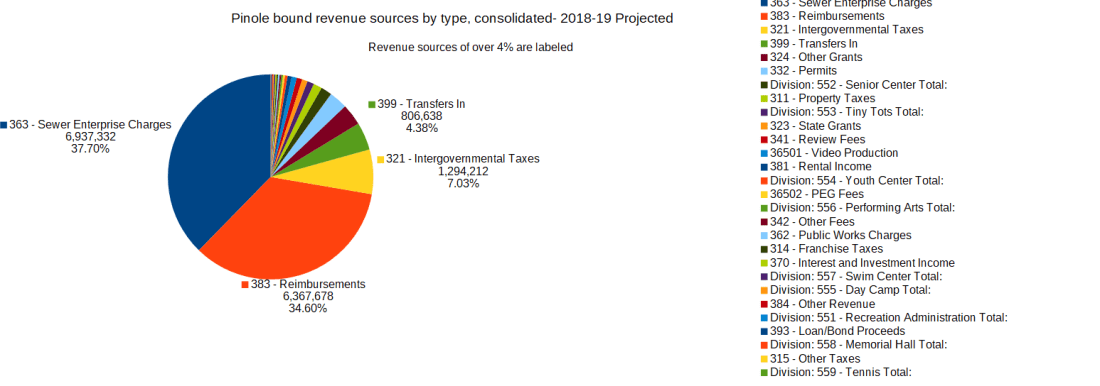
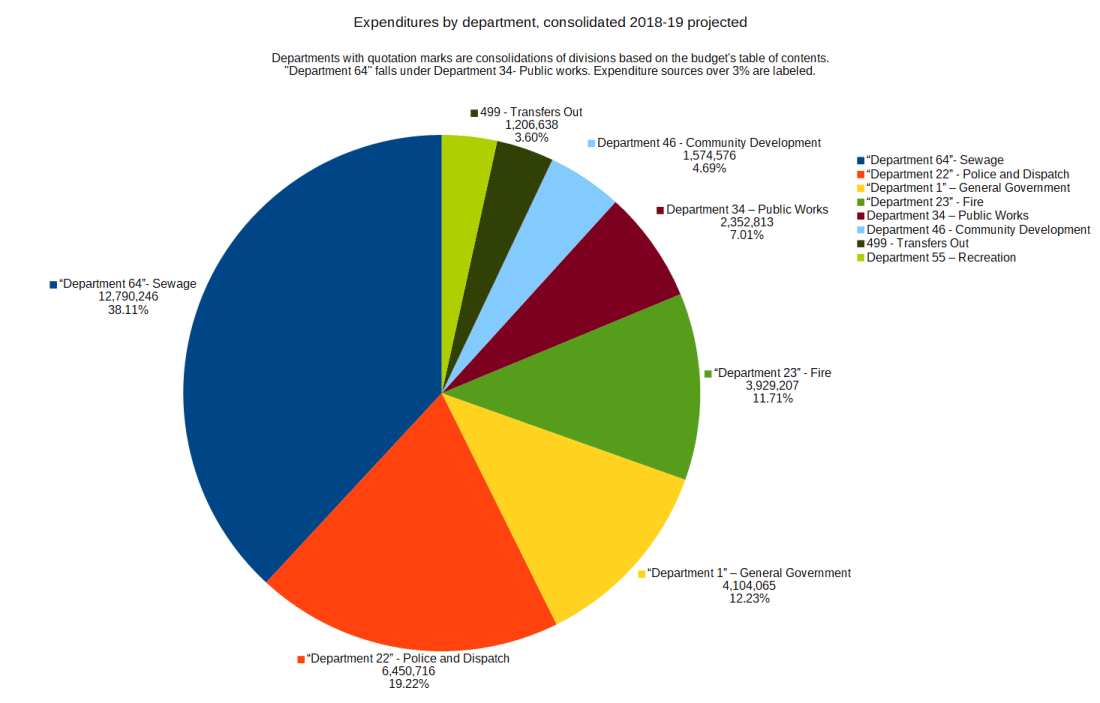
The sewer plant rebuild has cost and will continue to cost the city in the future a substantial amount- by my calculations, $10,404,995 of Public Work’s $15,672,834 expenditure budget is going purely to the sewer plant rebuild alone, with another $2,385,251 going to collections. That leaves $2,352,813 as Public Work’s non-Sewer budget. However, the city also gets significant bound revenue to offset that cost, from Hercules in the form of reimbursements and from sewer customers in wastewater treatment charges.

Because the 2006 and 2014 sales taxes are not included in the general fund, the amount the city relies on sales tax revenue isn’t immediately clear. If you just look at the general fund revenues, sales tax looks like 25% of the city’s revenue. But if you combine all the city’s revenue sources, sales tax goes up to 40% of the city’s unbound revenue. This is a risk when there’s an economic downturn.

The city’s 5-year projection predicts sales tax revenue will remain flat next year and the year after, when the city predicts there will be a recession (B 10-11). I think that might be overly optimistic- when the big box stores shut down, as Toys R Us and OSH already have, they aren’t necessarily going to be replaced by sources of equivalent sales tax value. Furthermore, in a recession discretionary spending tends to fall- I would expect a drop in sales tax value, not a slight increase.

I think the city needs to seek out new revenue sources, as the city itself notes in its Financial Policies:

i. The City will strive to maintain a diversified and stable revenue base that is not overly dependent on any land use, major taxpayer, revenue type, restricted revenue, inelastic revenue, or external revenue.

(A-9). Right now, I think the city is overly dependent on sales tax revenue, and is therefore at risk if and when a recession happens or if the big box stores keep on going out of business.

Pinole Budget Graphs

After several weeks of conversion and calculation, I present Pinole’s budget in spreadsheet form, along with associated graphs! Feel free to use this spreadsheet or the graphs so long as you grant credit to city staff for creating the budget and me for turning it into a spreadsheet. Before I go into the graphs, I’d like to note that the Sewer Treatment Plant rebuild falls under Public Works, and accounts for the vast majority of Pinole’s bound income and a majority of Public Work’s expenses.

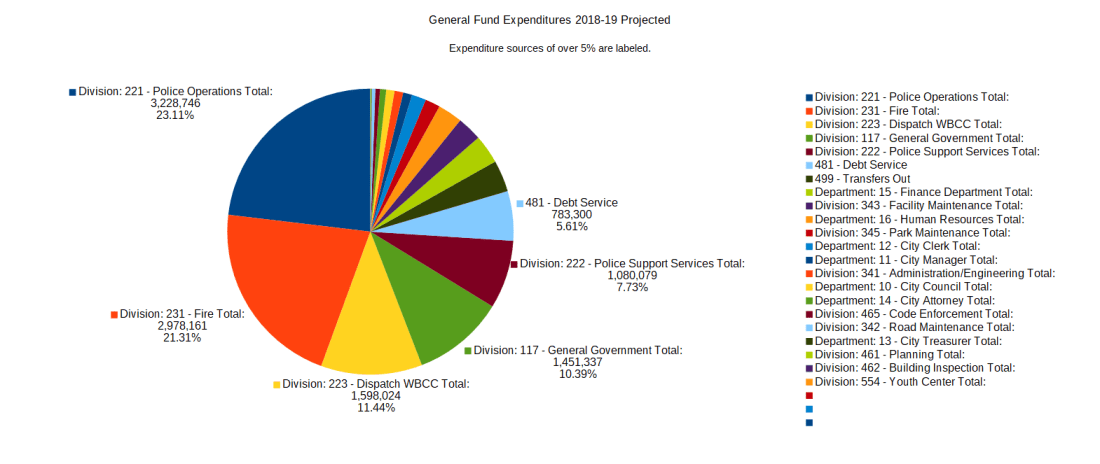
I will begin with graphs from the general fund info, but these graphs are incomplete. There are significant bound and unbound revenue sources as well as expenditure sources outside of the general fund, and my graphs accounting for all the funds follow the general fund charts below. First, pie charts of Pinole’s general fund revenue and expenditures for 2018-19 projected.

Pinole General Fund Revenue Sources Pie Graph

General Fund expenditures 2018-19 projected

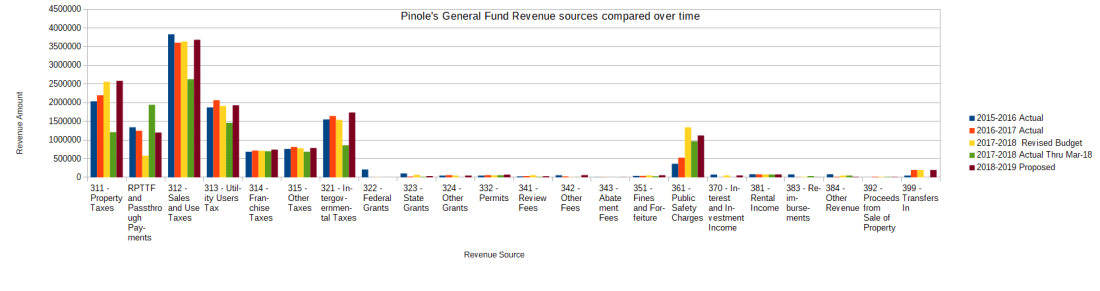
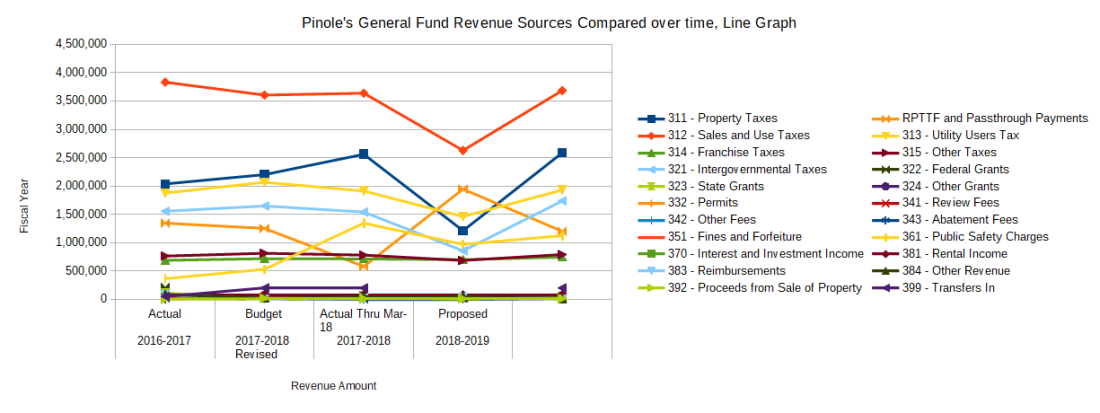
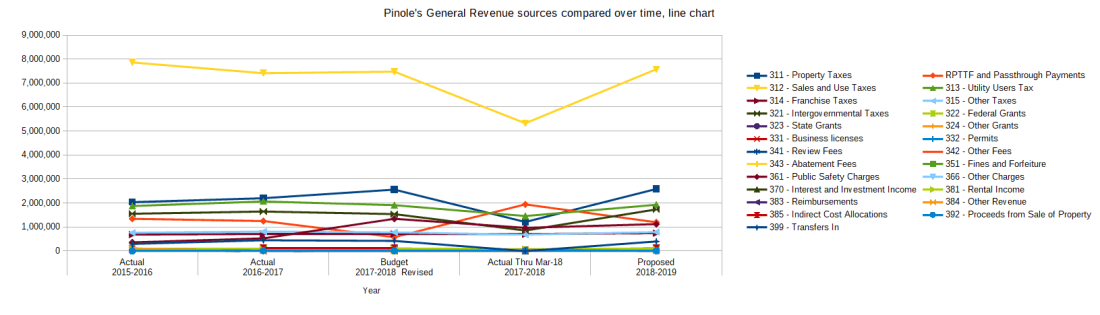
Then we move on to a comparison of general fund revenue sources over time in bar and line chart forms.

Pinole's General Fund Revenue Sources compared over time, Bar Graph

Pinole's General Fund Revenue Sources compared over time, Line Graph

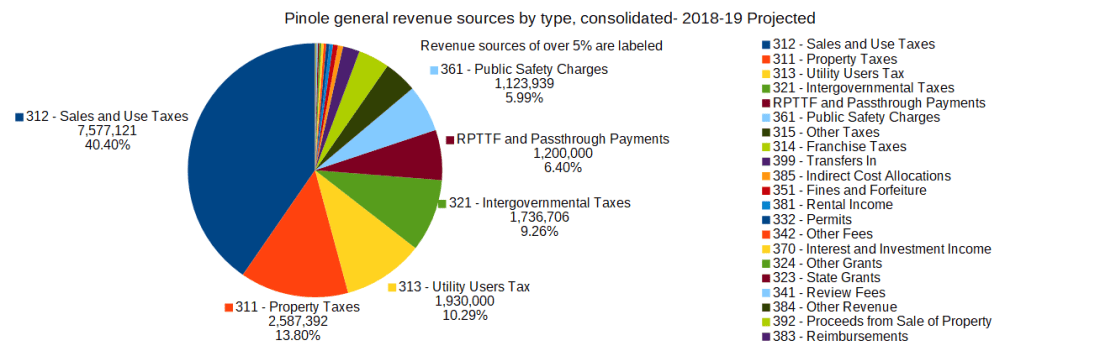
However, there are significant revenue and expenditure sources outside of the general fund. Therefore, we next have general and bound revenue for Pinole 2018-19 in pie graphs, followed by expenditures by department. Note that Sales and Use Taxes make up a full 40% of the city’s anticipated unbound revenue, and the Utility Users Tax makes up another 10%. Bound revenue is overwhelmingly (70%) linked to the sewer plant rebuild.

Pinole's General Revenue sources by type, consolidated 2018-19

Pinole's Bound Revenue sources by type, consolidated- 2018-19

Pinole's expenditures by department, 2018-19

The sewer plant rebuild is noted in its own category, but it belongs under Public Works. As noted in the graph, departments with quotation marks are made from divisions in the budget based on the table of content’s structuring.


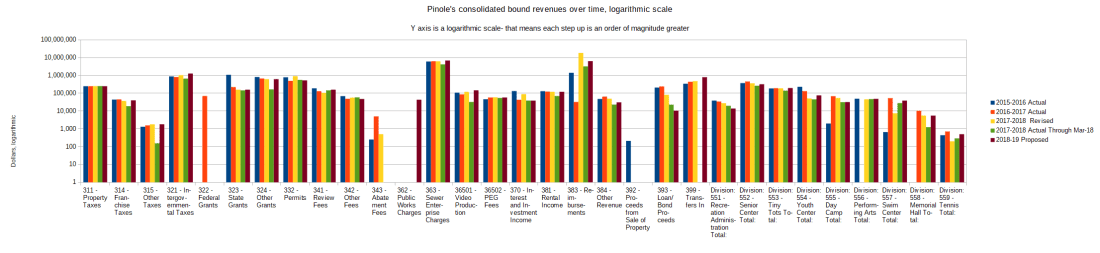
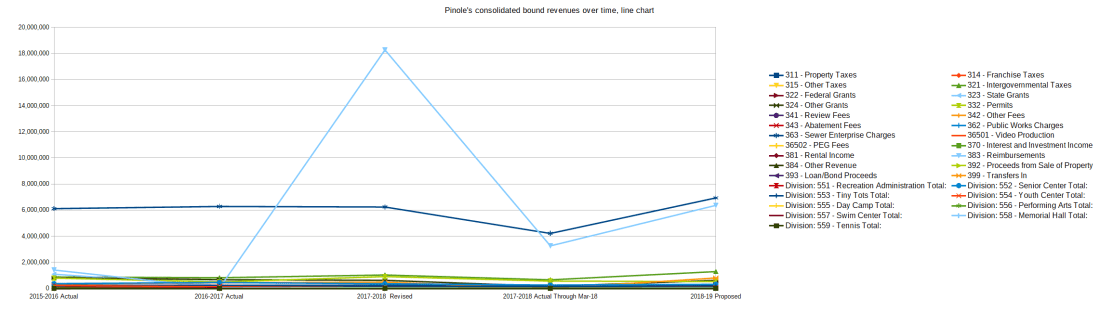
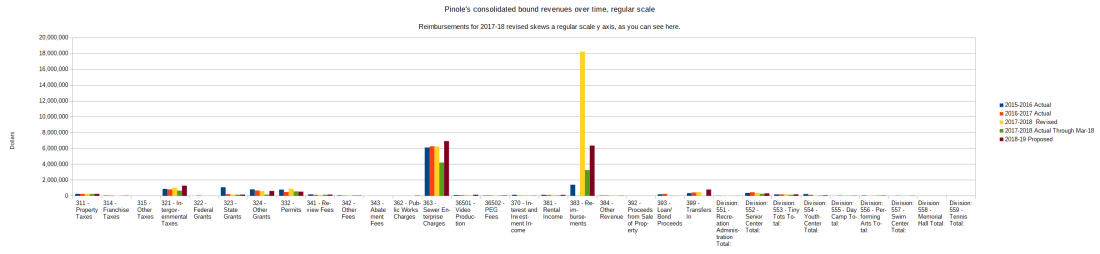
Finally, we have a comparison of overall revenue sources across time, general and bound in bar and line graphs. Due to the 18,277,900 dollar reimbursement in 2017-18 revised (see page B-1), the bound revenue bar graph is provided in logarithmic form, as that amount is a sufficient outlier to make a normal bar graph much less useful.

Pinole's General Revenue sources over time, bar graph

Pinole's General Revenue sources over time, line graph

Pinole's consolidated bound revenues over time, logarithmic bar chart

Pinole's consolidated bound revenues over time, line chart

Pinole's consolidated bound revenues over time, bar chart

Pinole’s Government Structure

The first step to reconnecting the government with the community is for people to know who all is in the government and what they do. Pinole is a general law city under a council-manager system, which means that there are certain laws we cannot make, and that city staff implement policy, not the council. I talked with the city manager at some length about what city staff did, and she gave me the following information. Items [in brackets] are my commentary.

First, some hyperlinks in case you want to look at one department in particular-

City Government overall

At the top level, there’s the City Manager and Assistant City Manager. Michelle Fitzer, the City Manager is in charge of all city departments, writes staff reports, letters and analysis. She also writes the city council’s agenda and any associated attachments. She also handles inter-agency cooperation, as well as sitting on the municipal pooling authority as Pinole’s representative. Finally, she does other projects as necessary.

Hector De La Rosa, the Assistant City Manager, is the head of HR, Recreation, and Pinole Cable TV. In addition, he’s in charge of the close out of Pinole’s Redevelopment Agency.

The City Attorney is under contract with Meyers/Nave, since the city does not need an attorney full-time and the expenses associated with having one at full-time rates and benefits would be substantial. This also allows for a broader range of knowledge than any one attorney might possess. The current attorney they have assigned to us is Eric Casher.

Fire Department

Scott Kouns is the head of the Fire Department. [There is one fire station in Pinole- there used to be two, but apparently the second station was built without an adequate funding stream to keep it open. It would cost the city 2.8 million dollars annually to keep the Pinole Valley Fire Station open.]

Police Department

Neil Gang is the head of the Police Department. Pinole has 38 police officers (the full staffing allocation), covering 3 beats- the Fitzgerald shopping mall complex, Pinole Valley, and the rest of Pinole.

Development Services

Tamara Miller is the Development Services Director and City Engineer. As such, she oversees planning, building, engineering, public works and the water pollution control plant. Ordinarily, the city would have building inspectors, but Pinole cannot afford to pay building inspectors at market rates, and so cannot find any.

Winston Rhodes is the planning manager, and oversees planning, building and code enforcement. There are 2 contractors doing code enforcement work as well.

Finance

Andrea Miller is the Finance Director. She oversees payroll, accounts payable and receivables (though the city does not have many accounts receivable). She also does bank reconciliations and deposits, along with reconciling cash payments received by the city. Finally, she also handles audits of Measure S and grants that the city has received. The Finance department also has 2 accounting specialists at 19 hours per week (just under the benefits threshold of 20 hrs/week).

Public Works

Public Works also has a public works specialist, for dealing with encroachment permits for work in public right of way, acting as a site inspector and doing project management. Public works is in charge of the city’s maintenance yard and the equipment there. They are also in charge of building maintenance, limited pothole repair (depending on the amount allocated in the city’s Capital Improvement Plan), sewer infrastructure, and infrastructure more broadly. Landscape maintenance is contracted out. Finally, public works does emergency response to accident cleanup and floods.

Water Pollution Control Plant

Ron Tobey is the plant manager. The plant treats and discharges waste water (sewage) according to state permits. This does not include stormwater- that goes to a completely different system. Or at least, it should. But because Pinole’s sewer infrastructure is in need of repair (with some being done in the current CIP), stormwater can infiltrate the sewer lines and increase Pinole’s wastewater costs. Pinole owns the land that the water treatment plant is on, and 50% of the plant itself. Hercules owns the other half of the plant. The cities share operating costs for the plant based on usage- so when stormwater from Pinole goes to the plant, it increases Pinole’s costs.

Pinole TV

Pinole runs its own cable TV channel, which has 2 full time employees and funding allocated for part time staff. The channel records and broadcasts council, planning commission and water pollution plant committee (and subcommittee) meetings. They also provide those services to Benecia, West Contra Costa Unified School District (WCCUSD), and WestCAT (West county transit- buses and dial-a-ride) under contract, and can gain revenue from those contracts.

Recreation

Recreation has an overall manager, whose name I do not know. There’s three sub-departments under Recreation- the Senior Center, the Youth Center, and Tiny Tots. Each has its own coordinator, with all other workers being part-time. There’s also the Swim Center, which is contracted out to the Pinole Seals. They have been doing well so far. Tiny Tots creates sufficient revenue to cover its expenses. The Senior Center does not. [There are several reasons for this- the center shifted to an online membership system, which many of their members did not transition into, the center has been maintained but not improved (as per the city’s silo system for department funding), and the city’s funding of the Senior Center is limited. As a result, the ambience of the senior center can be unpleasant (ref Council Member Long, City Council Meeting 8/21/18).]

The Youth Center was revamped recently to shift from an after-school focus to enrichment classes. There have not been many signups yet.

Recommendations for Candidates in the 2016 election

I find it harder to make choices between candidates than I do choosing whether to support or oppose a proposition. There are several races on this ballot where I think that both (or more candidates than I am allowed to select, for some of the multiple candidate positions) candidates would be qualified, vote in office in ways that I generally would approve of, and in general do a good job. But it’s my duty as a voter to choose.

That said, the race for the Presidency is not one of those races. Donald J Trump is a threat to the republic. His actions and rhetoric have done more to undermine the norms maintaining our civil society than anyone since at least McCarthy, and quite possibly since Calhoun. His support of racist, if not outright white supremacist groups and journalists has normalized their discourse and worsened race relations in the United States. His foreign policy positions seem tailor made to please one of his major supporters, the President of Russia Vladimir Putin- from weakening if not dismantling NATO to encouraging nuclear proliferation. His language and actions towards women make a hollow mockery of his claim that “no one respects women more than I do”- few candidates in the 20th century, let alone the 21st have been so blatant about their disrespect and contempt for women. His tax policies would create colossal long term debt to give tax breaks to him and his 1% friends. His “poll monitors” searching for non-existent voter fraud exist to intimidate minority voters in a tradition that goes back to the first KKK. And his outright refusal to accept the outcome of the election if he loses weakens the peaceful transition of power that has been a core part of our Republic since George Washington left office. But Donald Trump is not some Great Man standing alone. Many of his ideas are ideas that have been part of the Republican party since at least the 1980s, amplified to their natural conclusion.

From Ronald Reagan making a speech on “states rights” in Neshoba, near where civil rights workers were murdered in the 1960s to build his 1980 presidential campaign in the South, to constant Republican attacks on people dwelling in the inner cities (always understood to be minorities, often with racist assumptions attached), to mass disenfranchisement of African-American voters by GOP-controlled legislatures across the south after the supreme court’s dismantling of the voting rights act, the modern GOP has built its power on racism. For the most part, less blatantly than Donald Trump, but in the same way nonetheless.

But let’s say you want to set racism aside. Trump’s refusal to accept the outcome of the election is a logical progression of the GOP’s refusal to accept the legitimacy of Democratic presidents to govern. From the Birther conspiracy against Barack Obama that Trump played a major part in creating and perpetuating; to shutting down the government; to refusing to even vote on any supreme court nominee- first at the end of Obama’s term, and then into the entirety of Hillary’s hypothetical one; the GOP has acted to de-legitimize any Democratic president. Trump’s racism and degeneration of civil norms are simply the GOP’s actions taken to their logical conclusion.

As a result, I am voting against every single Republican candidate on my ballot, and I urge everyone to do the same to hasten the GOP’s rejection of Trump and Trumpism. Only a crushing defeat will force the GOP to abandon the racism that lies at the heart of Trump’s agenda.

President/Vice-President: Hillary Clinton/Tim Kaine
United States Senator: Kamala D Harris
United States Representative District 5: Mike Thompson
State Senator District 9: Nancy Skinner
Member of the State Assembly District 15: Tony Thurmond
Contra Costa County Board of Education Area 1: Fatima S. Alleyne
West Contra Costa Unified School District Governing Board (choose 2): Tom Panas, Mister Phillips
Supervisor for Contra Costa County District 5: Anamarie Avlia Farias
East Bay Municipal Utility District (EBMUD) Director Ward 1: Lesa R. McIntosh
San Francisco Bay Area Rapid Transit (BART) District Director District 7: Lateefah Simon

I am voting for Hillary Clinton because I believe that she is qualified, has the necessary experience to implement her policy goals both domestically and internationally in the face of adamant opposition, and would generally seek to implement policy goals that I agree with. There are some areas where I don’t agree with her- I dislike her working to undermine internet encryption, for example. But those areas are outweighed by the many areas where I do, including her commitment to overturn Citizens United.

The US Senate race is a hard race. Kamala D. Harris and Loretta L. Sanchez are both competent politicians who have the necessary experience to succeed as Senator and state that their policy goals align with mine. But Sanchez has sought out the support of Republican members of congress and worked to paint Harris as left-wing- which inclines me to support Harris.

I’m voting for Mike Thompson and Tony Thurmond because they’ve done competent jobs as the incumbents, and their opponents are Republicans.

The State Senate race for District 9 is another hard race. Nancy Skinner and Sandre R Swanson are both qualified, have prior experience in government, and would most likely seek to implement policy positions I would agree with. The question then becomes who has a higher priority on issues that I care about. Here Nancy Skinner wins- she argues that she wants to reduce income inequality, work in climate protection and criminal justice reform. By contrast, Sandre R Swanson says that education is his top priority (“I worked hard to make Education California’s top budgetary priority”). While I think that education and education funding are important, I don’t think that they should be my state senator’s highest priority. That’s why I’m voting for Nancy Skinner, but Sandre R Swanson remains a well-qualified candidate.

I’m voting for Fatima S. Alleyne because she argues for a uniform data-based approach to be applied to charter and traditional public schools alike, while also seeking to mitigate the harshness of our educational systems punishments towards students.

West Contra Costa Unified School District has had marked problems with its finances of late. Therefore, I support Tom Panas, because he did a fair amount of work to make the audit happen in the first place in his role on the oversight board, and hopefully his experience as an accountant would help prevent future issues. I also support Mister Phillips because of his legal experience- it will be useful for the board to have a member on it knowledgeable about the law rather than having to rely entirely on their counsel.

I’m voting for Anamarie Avila Farias because Federal Glover’s efforts have been primarily focused on East Contra Costa County, and it’s time that West Contra Costa county received a proper share of attention from the 5th district supervisor.

I’m voting for Lesa R. McIntosh because she’s done a competent job as EBMUD director, and is working to expand recycled water usage. I also can’t find much information on her opponent, other than her being CEO of exponential power Inc, which doesn’t really seem relevant to water issues.

While I appreciate Zachary Mallet’s efforts to extend BART along the I-80 corridor, his campaign to undermine the BART union has drawn too much of his focus, and if successful would undermine wages in the Bay Area generally. Therefore I oppose him. Lateefah Simon advocates for more transit-oriented housing development while maintaining affordable housing, and spending RR funds on infrastructure maintenance. She wants to achieve consensus rather than dividing workers against transit riders against people needing housing. She goes into more depth about the goals she wants to achieve than the other candidates opposing Mr. Mallet. For all of these reasons, I’m voting for Lateefah Simon for BART District 7 transit director.

2016 California Statewide Proposition Recommendations

Here are the propositions that I recommend voting for or against on this November’s CA statewide ballot (2016). I start with the propositions and a one sentence argument, then go into further depth below. When two propositions conflict, the one that gets more votes wins. This year, the propositions in conflict are 62 and 66 with each other, and 65 and 67 with each other.

  • Prop 51: No. It locks in current pro-developer fund allocations, and would direct resources to which ever district filed applications first, not based on need.
  • Prop 52: Yes. Because there’s no good reason to divert fees collected from hospitals to get matching federal Medi-Cal funds to another program, and this proposition makes it so that those fees can’t be diverted.
  • Prop 53: No. Because there’s no exemptions for emergencies, it would either block emergency repairs until the next regular vote or force a vote to be held while infrastructure was weakened by the emergency.
  • Prop 54: Yes. Bills should be made public before they are finalized, and in an emergency there’s an emergency exemption.
  • Prop 55: Yes. Until we reform our broken property tax system, schools and health care need funding and a tax on the wealthiest people is a good way to do it.
  • Prop 56: Yes. Our cigarette taxes are too low- raising them will make some people stop smoking.
  • Prop 57: Yes. Prosecutors have excessive power to make charging decisions- forcing a judge to decide whether juveniles should be tried as adults is a good idea.
  • Prop 58: Yes. This allows for more educational options in language immersion (particularly for students who are English fluent already).
  • Prop 59: Yes. Corporations are not persons, and should not be allowed to influence elections.
  • Prop 60: No. Regardless of whether compelling all adult film performers to wear condoms is necessary, creating a private cause of action will clog up the court system and make it more mercenary.
  • Prop 61: Yes. There’s no reason the state of California should pay more for drugs than the VA.
  • Prop 62: Yes. The death penalty is racist and gives us all the risk of executing innocent people- it needs to end.
  • Prop 63: Yes. Regulating firearms isn’t going to do much if ammunition isn’t regulated- 63 does that.
  • Prop 64: Yes. The criminalization of marijuana primarily affects minority populations– it’s long past time to decriminalize it.
  • Prop 65: No. If this passes, it will repeal the requirement for reusable plastic bags in 67.
  • Prop 66: No. If this proposition gets more votes than 62, the death penalty remains and professional organizations lose the ability to rebuke their members who help kill people for the state.
  • Prop 67: Yes. We should require all plastic bags to be reusable.

For citations, the proposition section number is given, and then the sub-levels based on the law that it’s modifying. For example, the segment on locking in bond law for proposition 51 is noted by the proposition section (3), then the Part listed as the header under that section (70), then the chapter within that part (2), then the article within that chapter (1), then the subsection within that article (110122.d). The links to the text of the propositions at the start of each paragraph are to pdfs on the secretary of state’s website.

Proposition 51 locks in bond law for the next four years (Section 3, Part 70, Chapter 2, Article 1, 101122.d), preventing any modification of how funds would be spent from the bonds. As the opponents note, there’s no provision for need in deciding in what order funds would be allocated, so the wealthier districts that could file their applications sooner would be better able to benefit.

Proposition 52 locks in hospital fees used to get federal medi-cal matching funds into the CA constitution. Unlike most initiatives, however, it can be repealed by a 2/3rds vote of the legislature (Section 3, Section 3.5, (c)). It’s a good idea- the fees are paid for a purpose, the benefit is ongoing, and this prevents the fees from being redirected and causing the state to shortchange medi-cal patients. If it turns out for some reason that this causes a problem, the legislature can repeal it, unlike most propositions.

Proposition 53 requires that all revenue bonds sold by the State (not sub-State districts like cities, counties, or districts formed to fulfill local responsibilities) of 2 billion dollars or more be put to a vote of the entire state. This amount is adjustable for inflation. However, it would block Joint Powers Authorities (combinations of cities) from passing revenue bonds without a vote (depending on how narrowly “local governmental functions within limited boundaries” (Sec 4 Sec 1.6(a)). I agree with the opponent’s argument. The fact that there’s no exemptions for emergencies and that non-State actors are defined too narrowly mean that in the case of a disaster, recovery could be delayed until the next election- precisely when the infrastructure for holding an election would be at its weakest.

Proposition 54 is a good proposition- it creates more transparency by mandating that records of proceedings be kept accessible to the public online for a minimum of 20 years (Sec 5.2, 10248(a(6)), and it requires that bills be made available to the public online for three days prior to a vote (Sec 4.2, Sec 8(b(2)). I think this is a good idea- we should be able to know about and petition our representatives on a bill before it becomes law. If it’s an emergency, there’s an exemption for that (Sec 4.2, Sec 8(b(2)) if the governor declares a state of emergency, maintaining separation of powers.

Proposition 55 extends the increased income tax from 2019 to 2031 (Section 4, Section 36, 8,8,f,2- segment referred to as subsection f). It’s a 1% increase between 250,000 and 300,000 (subsection f, 2, A, i), 2% increase between 300,000 and 500,000 (ibid, ii), and 3% increase on all income over 500,000 (ibid, iii). I think this is worthwhile- school funding hasn’t recovered fully from the recession, and until Proposition 13 is repealed property taxes won’t be a reliable source of funding.

As Proposition 56‘s declarations note, California has a tobacco tax far below nearby states- the lowest adjacent state tax is still 44 cents higher, and Arizona has a $2 tax (Section 1, p). It expands the definition of tobacco to include all nicotine containing products made for human consumption, except for smoking cessation aids (Section 3.1, Section 20121, b). It also raises the tax by 2 dollars a pack (Section 4.1, Article 2.5, 30130.52 (b(1(B)))). I think this is worthwhile- increased smoking costs will compel some people to quit, and since nearby taxes are relatively high it’ll remove California as a source of smuggling to other states (while not creating a significant incentive for smuggling from them).

Proposition 57 bars transfers of minors under 14 to adult court (section 4.2, Section 07 (b)), and requires minors 16 or older and 14 and 15 year olds who committed particular crimes to get a court order from a juvenile court in order to be tried in an adult criminal court (Section 4.2, Section 707(a(2))). This puts a check on prosecutorial discretion, which is a good thing. It also makes nonviolent felony offenders eligible for parole after serving the full term for their primary offense (not counting enhancements or other sentences) (Section 3, Section 32(1)). This limits the power of prosecutors to advocate for consecutive sentences as another threat in plea bargaining, and should lead to less crowded prisons. The act can be amended by majority vote of the legislature (section 5) to further its purposes, which is easier than amendment typically is.

Proposition 58 encourages the creation of dual-language immersion programs for the benefit of native English speakers and English learners (Section 4, Section 306 (c)), and removes the existing prohibition on bilingual programs (strikeouts in Section 3, Section 305 and throughout the proposition). It does not prohibit continuing existing English immersion programs (I.e, the standard method used since the prior proposition on this topic in 1998 banned bilingual programs) (ibid, (c(3)). I think this is a good idea- it provides more opportunities for native English speakers, maintains English immersion programs for parents who think that that method is the best for their children, and allows the creation of bilingual programs for communities that can support it.

Proposition 59 states that it is the will of the people of California that Citizens United should be overturned by a constitutional amendment, that corporations are not persons, and that our legislators should do everything in their constitutional power to make this happen. Unlike most of the other propositions, it doesn’t actually compel any action- but it’s still a worthwhile expression of sentiment.

Proposition 60 has a private cause of action if the state doesn’t sue someone (Section 4.7, Section 6720.6(a), and rewards a quarter of the winnings to the private individual (ibid, (d)). This is not a good idea. Our court system is already overloaded with cases- we don’t need to create an incentive for private individuals to sue (and they only have to pay the defendant’s fees if the litigation was “frivolous or in bad faith”, which seems like a high bar (ibid).

Proposition 61 has some problems (making the proponent an officer of the state if the Attorney General doesn’t defend the act (Section 10) seems like a bad idea). I’m not sure why the Medi-Cal managed care program is explicitly excluded either (section 4, Section 14105.32, b). But the core idea that the maximum price the state of California will pay for any drug is the same as what the VA pays (ibid, a)is a good idea- the manufacturers clearly can make the drugs at that price, and California has a big enough population to have bargaining power. Hopefully, it’ll reduce some of the skyrocketing prescription drug costs for everyone.

Proposition 62 strikes the death penalty from the constitution. It’s well past time that we did so. The death penalty is applied in a racially biased manner, and has killed and undoubtedly will in the future kill innocent men and women.

Proposition 63 regulates all ammunition sales, requiring their tracking starting in 2019 (Section 8.13, Section 30352 (a and b)). It creates a centralized list of all individuals who are authorized to purchase ammunition in 2019, accessible only to law enforcement agencies (Sec 8.15, Article 4, Section 30370, c). It also requires a licensed vendor to at least be involved in the ammunition purchase process (Section 8.6, Section 30312, a). I think these are good ideas. Ammunition is what ultimately kills people- a gun without bullets is a paperweight. Controls on ammunition should reduce gun violence.

Proposition 64 is 22 pages long. It changes criminal law (making the possession and growth of small amounts of marijuana for non-commercial purposes legal (Section 4.4 and Section 4.5), outlawing smoking marijuana anywhere where smoking tobacco is prohibited (Section 4.6, Section 11362.3, a(1)), having an open container of marijuana in any vehicle used for transportation while it’s in use (ibid, a 4), possessing or using marijuana on school grounds while youth are present (ibid, a 5), smoking or ingesting marijuana while driving or flying or boating (ibid, a 7), smoking or ingesting marijuana while in a vehicle except as permitted by local agencies (at least, that’s what I think the reference to section 26200 implies) and making most of those infractions (Section 4.7)). It sets up an entire regulatory infrastructure for all aspects of marijuana production, from growing to processing to testing to distribution to retail (Division 10). In general, Marijuana is barred to individuals under 21 years of age, except with a medical exemption (Division 10, Chapter 14). Possession of more than 28.5 grams of cannabis or 4 grams of concentrated cannabis is punished by community service for under 18s, an infraction with a 100 dollar fine for individuals between 18-21, and imprisonment for not more than 6 months and/or a 500 dollar fine for anyone over 21 (Section 8.1, Section 11357). So it reduces several current misdemeanors to infractions, but maintains a fair amount of the current criminal apparatus. I still think it’s worth passing- many people that would have previously been convicted would not be under this law, and given the disproportionate racial bias of drug arrests reducing them is worthwhile.

Proposition 65 is in conflict with Proposition 67, and I think 67 is the superior proposition because it requires the use of reusable plastic bags.

Proposition 66 is in conflict with Proposition 62, and would maintain the death penalty if passed. Therefore, I urge you to vote against it. Furthermore, it would bar professional associations (like the AMA) from punishing doctors who help the state kill people, by administering executions or devising methods of execution (Section 12, Section 3604.3, c).

Proposition 67 bans non-compostable single-use plastic bags (Article 3). This is a good thing- non-compostable single use plastic bags clutter up the environment and degrade exceptionally slowly.