Local Propositions

There are two local propositions on the ballot in Pinole- measure R from the county, a measure to tax marijuana growers in unincorporated areas, and Measure C from the city of Pinole, a measure to extend the existing Utility User’s tax (UUT) without a sunset clause.

I support Measures R and C.

Measure R seems like a reasonable tax levy to cover the costs to the county of regulating those products. I support it.

While I would have preferred a process that allowed for more stakeholder input on Measure C, and would like to have a Citizen’s Budget Oversight Committee created in the future to provide that input, I support Measure C. The city is already overly reliant on sales tax revenue as is (as I’ve gone over at some length on my platform and in my review of the city’s budget in text and in graph forms). The loss of the UUT revenue would make the city even more reliant on sales taxes, which would leave us vulnerable to the economic downturn we know is coming. While the city can place the UUT on the ballot again if it does not pass in this election, it will incur substantial financial costs in doing so. The city will be required to create two budgets, one with the UUT revenue and one without. This will be a substantial additional demand on staff time. In addition, it will greatly increase uncertainty as to whether the city would be able to pay all of its employees, harming recruiting efforts. For all of these reasons, I support Measure C.

Pinole’s Budget in Brief

In brief, Pinole’s budget can broadly be divided into 4 categories- expenses and revenue linked to the sewer plant rebuild; the 2006 sales tax, expenditures linked to which go to police, fire and dispatch; the 2014 sales tax, expenditures linked to which go to a much broader array of city agencies; and everything else (the general fund). Depending on your preference, you can get the pdf budget here or the spreadsheet budget here.

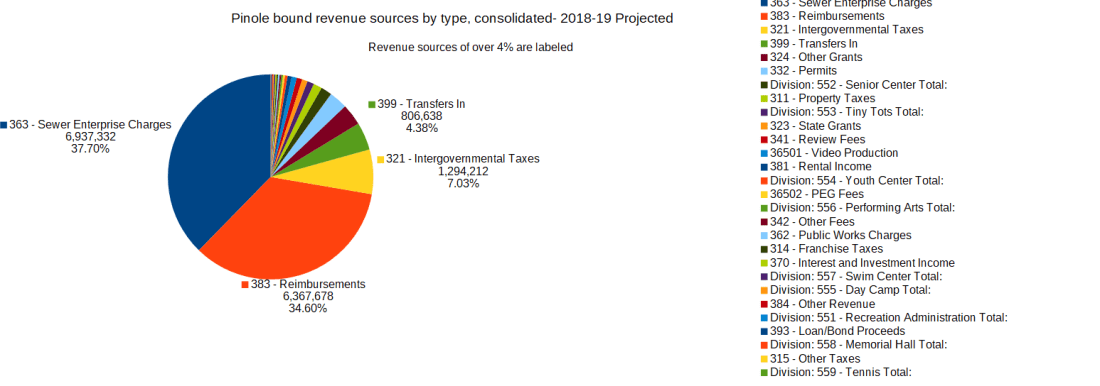
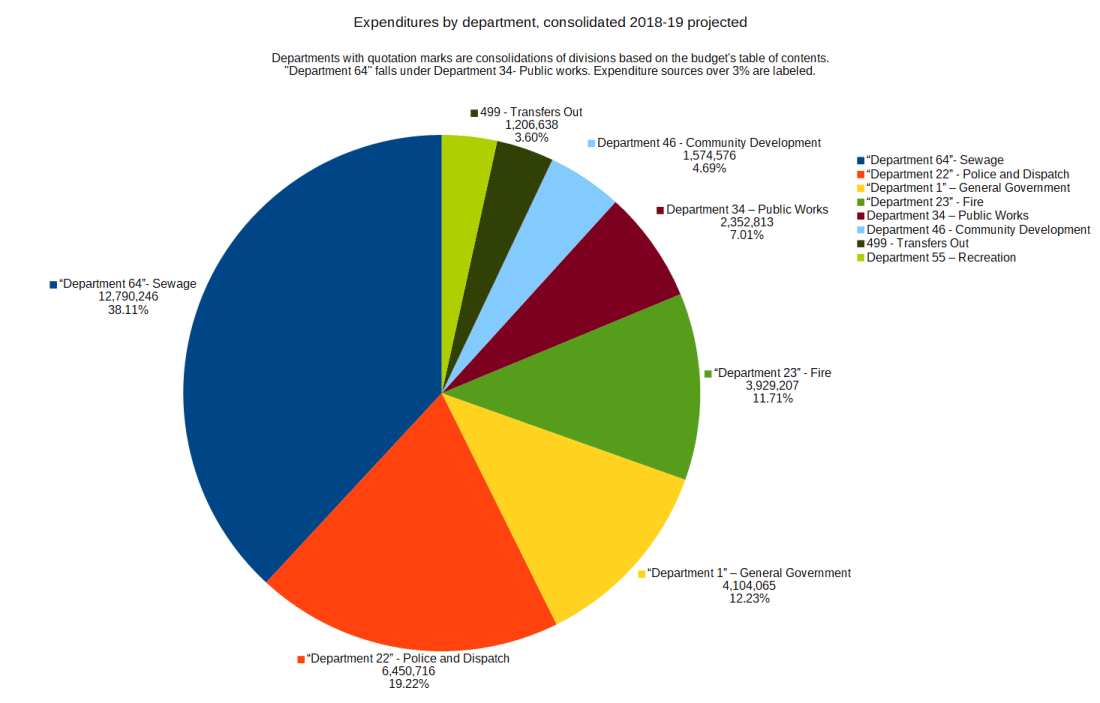
The sewer plant rebuild has cost and will continue to cost the city in the future a substantial amount- by my calculations, $10,404,995 of Public Work’s $15,672,834 expenditure budget is going purely to the sewer plant rebuild alone, with another $2,385,251 going to collections. That leaves $2,352,813 as Public Work’s non-Sewer budget. However, the city also gets significant bound revenue to offset that cost, from Hercules in the form of reimbursements and from sewer customers in wastewater treatment charges.

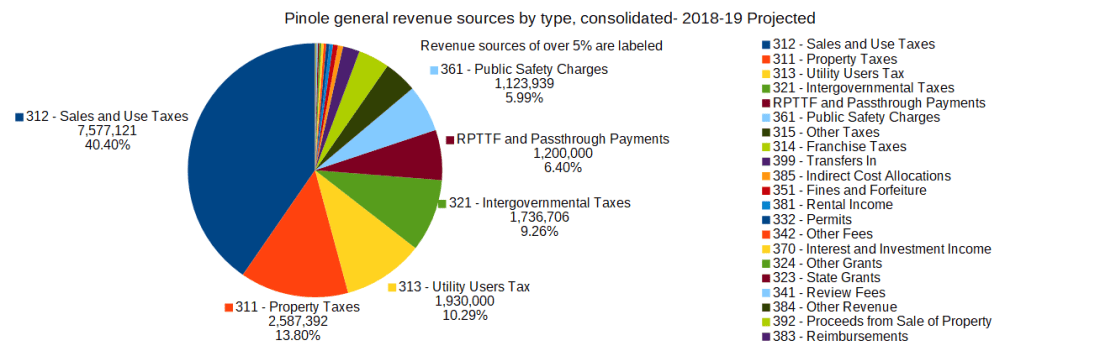
Because the 2006 and 2014 sales taxes are not included in the general fund, the amount the city relies on sales tax revenue isn’t immediately clear. If you just look at the general fund revenues, sales tax looks like 25% of the city’s revenue. But if you combine all the city’s revenue sources, sales tax goes up to 40% of the city’s unbound revenue. This is a risk when there’s an economic downturn.

The city’s 5-year projection predicts sales tax revenue will remain flat next year and the year after, when the city predicts there will be a recession (B 10-11). I think that might be overly optimistic- when the big box stores shut down, as Toys R Us and OSH already have, they aren’t necessarily going to be replaced by sources of equivalent sales tax value. Furthermore, in a recession discretionary spending tends to fall- I would expect a drop in sales tax value, not a slight increase.

I think the city needs to seek out new revenue sources, as the city itself notes in its Financial Policies:

i. The City will strive to maintain a diversified and stable revenue base that is not overly dependent on any land use, major taxpayer, revenue type, restricted revenue, inelastic revenue, or external revenue.

(A-9). Right now, I think the city is overly dependent on sales tax revenue, and is therefore at risk if and when a recession happens or if the big box stores keep on going out of business.

Pinole Budget Graphs

After several weeks of conversion and calculation, I present Pinole’s budget in spreadsheet form, along with associated graphs! Feel free to use this spreadsheet or the graphs so long as you grant credit to city staff for creating the budget and me for turning it into a spreadsheet. Before I go into the graphs, I’d like to note that the Sewer Treatment Plant rebuild falls under Public Works, and accounts for the vast majority of Pinole’s bound income and a majority of Public Work’s expenses.

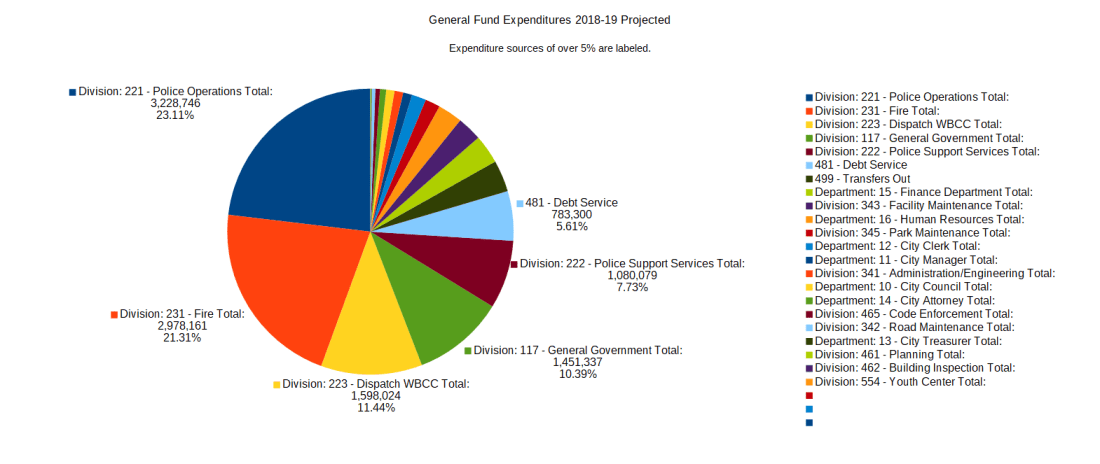
I will begin with graphs from the general fund info, but these graphs are incomplete. There are significant bound and unbound revenue sources as well as expenditure sources outside of the general fund, and my graphs accounting for all the funds follow the general fund charts below. First, pie charts of Pinole’s general fund revenue and expenditures for 2018-19 projected.

Pinole General Fund Revenue Sources Pie Graph

General Fund expenditures 2018-19 projected

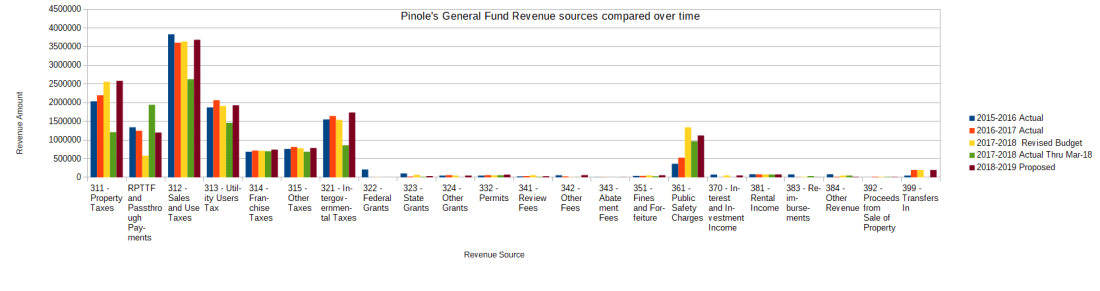
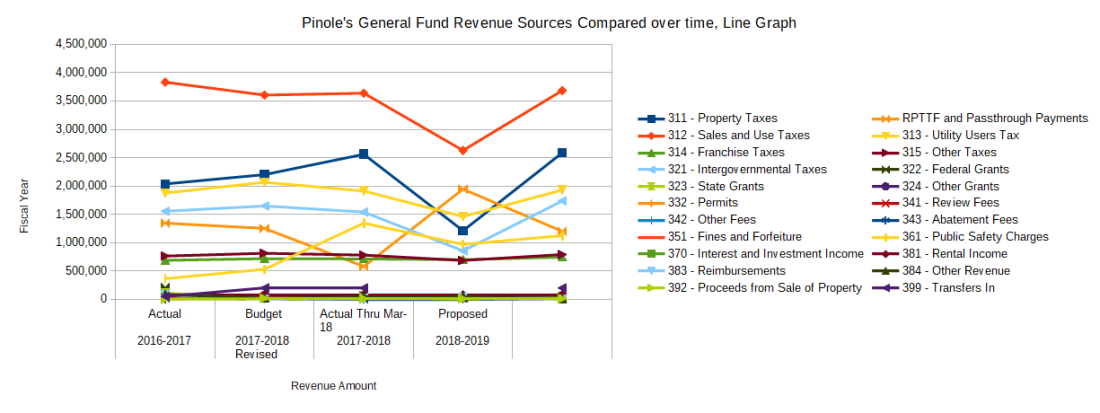
Then we move on to a comparison of general fund revenue sources over time in bar and line chart forms.

Pinole's General Fund Revenue Sources compared over time, Bar Graph

Pinole's General Fund Revenue Sources compared over time, Line Graph

However, there are significant revenue and expenditure sources outside of the general fund. Therefore, we next have general and bound revenue for Pinole 2018-19 in pie graphs, followed by expenditures by department. Note that Sales and Use Taxes make up a full 40% of the city’s anticipated unbound revenue, and the Utility Users Tax makes up another 10%. Bound revenue is overwhelmingly (70%) linked to the sewer plant rebuild.

Pinole's General Revenue sources by type, consolidated 2018-19

Pinole's Bound Revenue sources by type, consolidated- 2018-19

Pinole's expenditures by department, 2018-19

The sewer plant rebuild is noted in its own category, but it belongs under Public Works. As noted in the graph, departments with quotation marks are made from divisions in the budget based on the table of content’s structuring.


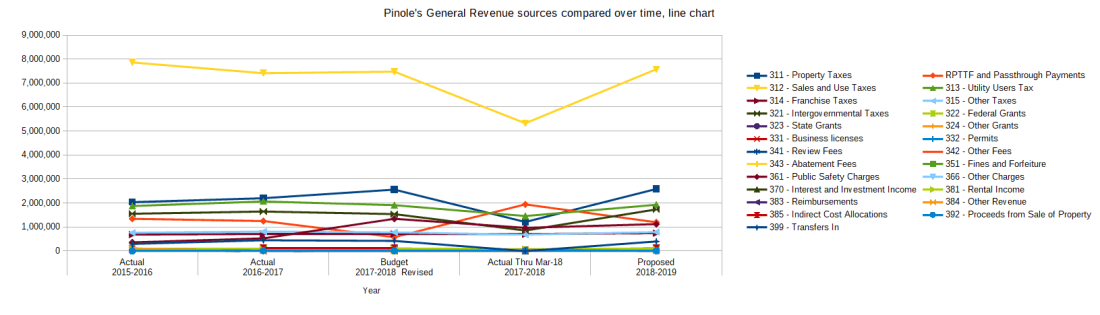
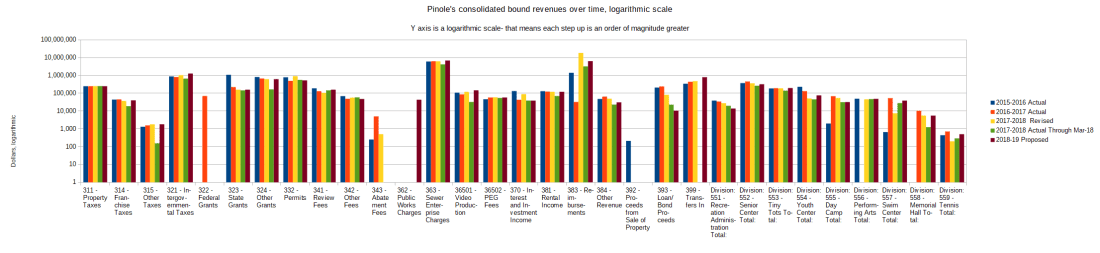
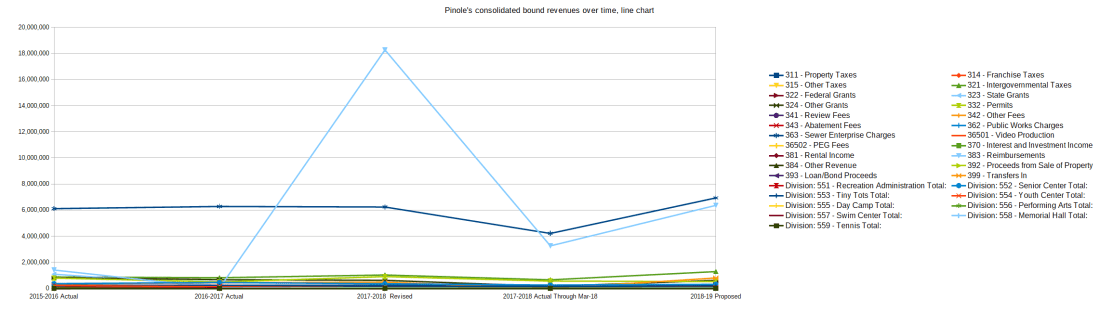
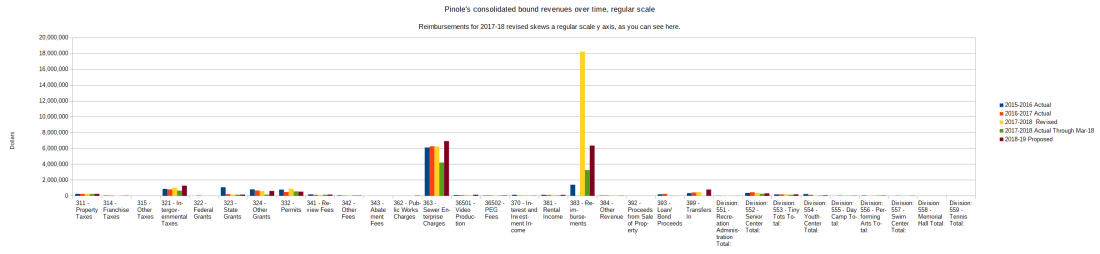
Finally, we have a comparison of overall revenue sources across time, general and bound in bar and line graphs. Due to the 18,277,900 dollar reimbursement in 2017-18 revised (see page B-1), the bound revenue bar graph is provided in logarithmic form, as that amount is a sufficient outlier to make a normal bar graph much less useful.

Pinole's General Revenue sources over time, bar graph

Pinole's General Revenue sources over time, line graph

Pinole's consolidated bound revenues over time, logarithmic bar chart

Pinole's consolidated bound revenues over time, line chart

Pinole's consolidated bound revenues over time, bar chart

Pinole’s Government Structure

The first step to reconnecting the government with the community is for people to know who all is in the government and what they do. Pinole is a general law city under a council-manager system, which means that there are certain laws we cannot make, and that city staff implement policy, not the council. I talked with the city manager at some length about what city staff did, and she gave me the following information. Items [in brackets] are my commentary.

First, some hyperlinks in case you want to look at one department in particular-

City Government overall

At the top level, there’s the City Manager and Assistant City Manager. Michelle Fitzer, the City Manager is in charge of all city departments, writes staff reports, letters and analysis. She also writes the city council’s agenda and any associated attachments. She also handles inter-agency cooperation, as well as sitting on the municipal pooling authority as Pinole’s representative. Finally, she does other projects as necessary.

Hector De La Rosa, the Assistant City Manager, is the head of HR, Recreation, and Pinole Cable TV. In addition, he’s in charge of the close out of Pinole’s Redevelopment Agency.

The City Attorney is under contract with Meyers/Nave, since the city does not need an attorney full-time and the expenses associated with having one at full-time rates and benefits would be substantial. This also allows for a broader range of knowledge than any one attorney might possess. The current attorney they have assigned to us is Eric Casher.

Fire Department

Scott Kouns is the head of the Fire Department. [There is one fire station in Pinole- there used to be two, but apparently the second station was built without an adequate funding stream to keep it open. It would cost the city 2.8 million dollars annually to keep the Pinole Valley Fire Station open.]

Police Department

Neil Gang is the head of the Police Department. Pinole has 38 police officers (the full staffing allocation), covering 3 beats- the Fitzgerald shopping mall complex, Pinole Valley, and the rest of Pinole.

Development Services

Tamara Miller is the Development Services Director and City Engineer. As such, she oversees planning, building, engineering, public works and the water pollution control plant. Ordinarily, the city would have building inspectors, but Pinole cannot afford to pay building inspectors at market rates, and so cannot find any.

Winston Rhodes is the planning manager, and oversees planning, building and code enforcement. There are 2 contractors doing code enforcement work as well.

Finance

Andrea Miller is the Finance Director. She oversees payroll, accounts payable and receivables (though the city does not have many accounts receivable). She also does bank reconciliations and deposits, along with reconciling cash payments received by the city. Finally, she also handles audits of Measure S and grants that the city has received. The Finance department also has 2 accounting specialists at 19 hours per week (just under the benefits threshold of 20 hrs/week).

Public Works

Public Works also has a public works specialist, for dealing with encroachment permits for work in public right of way, acting as a site inspector and doing project management. Public works is in charge of the city’s maintenance yard and the equipment there. They are also in charge of building maintenance, limited pothole repair (depending on the amount allocated in the city’s Capital Improvement Plan), sewer infrastructure, and infrastructure more broadly. Landscape maintenance is contracted out. Finally, public works does emergency response to accident cleanup and floods.

Water Pollution Control Plant

Ron Tobey is the plant manager. The plant treats and discharges waste water (sewage) according to state permits. This does not include stormwater- that goes to a completely different system. Or at least, it should. But because Pinole’s sewer infrastructure is in need of repair (with some being done in the current CIP), stormwater can infiltrate the sewer lines and increase Pinole’s wastewater costs. Pinole owns the land that the water treatment plant is on, and 50% of the plant itself. Hercules owns the other half of the plant. The cities share operating costs for the plant based on usage- so when stormwater from Pinole goes to the plant, it increases Pinole’s costs.

Pinole TV

Pinole runs its own cable TV channel, which has 2 full time employees and funding allocated for part time staff. The channel records and broadcasts council, planning commission and water pollution plant committee (and subcommittee) meetings. They also provide those services to Benecia, West Contra Costa Unified School District (WCCUSD), and WestCAT (West county transit- buses and dial-a-ride) under contract, and can gain revenue from those contracts.

Recreation

Recreation has an overall manager, whose name I do not know. There’s three sub-departments under Recreation- the Senior Center, the Youth Center, and Tiny Tots. Each has its own coordinator, with all other workers being part-time. There’s also the Swim Center, which is contracted out to the Pinole Seals. They have been doing well so far. Tiny Tots creates sufficient revenue to cover its expenses. The Senior Center does not. [There are several reasons for this- the center shifted to an online membership system, which many of their members did not transition into, the center has been maintained but not improved (as per the city’s silo system for department funding), and the city’s funding of the Senior Center is limited. As a result, the ambience of the senior center can be unpleasant (ref Council Member Long, City Council Meeting 8/21/18).]

The Youth Center was revamped recently to shift from an after-school focus to enrichment classes. There have not been many signups yet.