My Platform

My Platform

Securing Pinole’s financial future

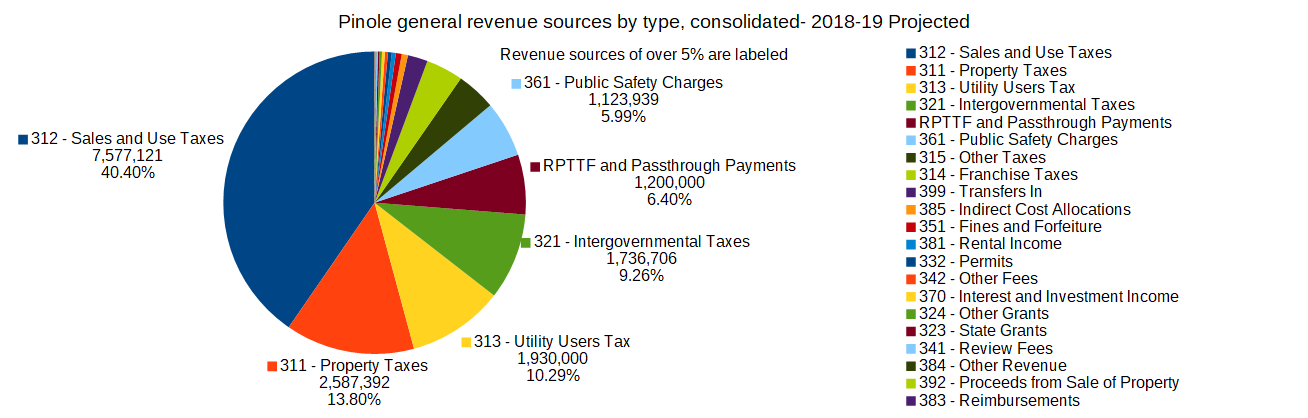
I’m running because I think Pinole needs to secure it’s financial future. While Pinole’s budget is in balance now, there are future threats which will need to be addressed. Since propositions 13 and 218 sharply limit how much revenue Pinole can raise from property taxes, the city has relied on Sales tax as the city’s largest revenue source (by far, over 40% of unbound revenue) (budget, pages B-1 and B-2), and the Utility User Tax (UUT) as a significant source of income (10.29% of this year’s unbound revenue, as noted on page B-1). When times are good, like they are now, this isn’t a huge problem. An influx of customers keeps most of the chains open and sales tax revenues high. But when they go bad, the city doesn’t have many counter-cyclical revenue sources. Furthermore, in the city’s own 5-year projection for the general fund, it anticipates significant deficits every single year from 2019 onwards, ranging from $397,603 in the 2019-20 budget year to -$1,539,485 in the 2022-23 budget year, primarily due to marked increases in benefits and insurance costs (City budget, B-10).

In the long term, the big box mall store model is going out of favor, and as the mega-chains collapse (like Toys R Us and OSH), the tenants that replace them might not provide sales tax revenue at all. Finally, the utility user tax (UUT) has been declining over time with the phasing out of landlines, and could potentially drop precipitously if there’s widespread solar installation. I think the city should investigate new counter-cyclical revenue sources.

That said, if the UUT fails the city will immediately face a 1.9 million dollar deficit. I will be campaigning for the UUT measure on this fall’s ballot, Measure C, and urge all voters in Pinole to vote for it. But right now, people are disinclined to vote for it because they don’t see the concrete benefits the government provides. That’s why I’m working on:

Reconnecting Pinole with its government

People feel out of touch with the city government, and vice versa. Even though there’s lots of information that the public can access, people don’t necessarily know that. The city’s website redesign might mitigate some of this, but the city needs to do more direct outreach via social media, mailings and postings at popular community gathering places. I will be doing some of this outreach as part of my campaign, and will continue to do so if elected.

City documents aren’t always easy to understand. Take the city’s budget. The budget proper, while it goes to some lengths to explain items to the public, has no graphs in it whatsoever. You can watch the video of the presentation on the budget which does have graphs, but I wouldn’t call that accessible. I made some graphs from the city’s budget, which you can find here. In addition, I will write a detailed as well as top-level analysis of this year’s budget as I understand it in another blog post. You can find the top-level analysis here.

Finally, most working-age adults cannot attend Tuesday night council meetings to give their input on the city’s agenda items after Citizens to be Heard. I am going to ask the public what meeting times would be easiest to attend, so it would be easier for members of the public to give their input. If the Council is unwilling to change meeting times, at the very least it should have Citizens to be Heard immediately after closed session.

But even if all of these things are done, there’s not necessarily concrete things that the government can point to within the operating budget. That’s why I think we need to work towards having concrete things to point to- like having the library be open every day of the week, and in the longer term reopening the Pinole Valley Fire Station.

Renewing the Library and reopening the Pinole Valley Fire Station

I think one of the major challenges we face as a community is that we lack community institutions for families and non-senior adults. Certainly, there’s the senior center for seniors, and the youth center for youth. But for working-age adults and families as a whole, there isn’t a natural community gathering place.

I think the Library can and should become that place. There’s already a large space separate from the library proper that is used for community events, and it could easily be converted into a community center outright. The problem is that the city of Pinole hasn’t funded maintenance of the library for years, and so it’s only open every other weekday. I would work to have the city take control of the library, fund it so that it can be open every weekday, and create a community gathering space there. This would strengthen the community as well as the library.

Doing this would make it clear that government can bring benefits to the community. On the basis of this, it would be possible to start working towards more ambitious projects, like reopening the Pinole Valley Fire Station. The city has never had the necessary revenue stream to keep that station open, but in rush hour it’s a public safety risk having the only station be on the other side of the high school. While the city is limited in what revenue sources it can seek by state law, I believe that keeping a fire station open is a classic community benefit for a parcel tax levy. I would prefer to adjust the property tax rate directly, but Proposition 13 bars that. Of course right now, the community is divided enough that even existing tax measures draw opposition when they are up for renewal.

Bringing Pinole together

And so, finally, I think we need to come together as a community. That starts with my listening to as many people as I can reach from all walks of life- from the Labor Council to the Rotary Club, from the Police Department to the Pinole Progressive Alliance. I will listen to all sides so that I can represent everyone, and so that I can understand everyone’s perspectives. I will be open minded, because it’s the right thing to do, and because representing the community is impossible with a closed mind. If you can’t understand other people’s perspectives, you can’t represent them properly.

Why I am Running

Pinole can be better- a city where there’s a thriving community that’s engaged with its government, which in turn provides the services and spaces to help the community thrive. But by default, this will not happen. Inertia in the structures of government and the challenges people face in their everyday lives has lead to disengagement with government, which will lead to a backlash against government revenue sources, which will lead to fewer services and on in a cycle of decline.

I plan to break that cycle at the root, by getting information on what the government does out to the community. The Pinole Library would be an ideal space for that, but it’s only open every other weekday because the city doesn’t pay for its maintenance. I think the city should fully fund the library’s maintenance so it can act as the heart of the community once again.

2018 California Primary Recommendations

2018 California Primary Recommendations

Propositions

Proposition 68- Yes. This propositon creates $4 billion in new statewide bond debt to fund parks, climate resilience and water quality. The text of the proposition (http://voterguide.sos.ca.gov/pdf/text-proposed-laws.pdf) has controls to ensure limited funds are spent on administrative and planning costs, and explicitly directs funds to disadvantaged communities to rehabilitate and build new parks there (disadvantaged being defined as “a community with a median household income less than 80 percent of the statewide average.” (Propositions Proposed Laws full text, page 5).

Proposition 69- Yes. It amends the California constitution to ensure that the new funds raised by the gas tax hike can’t be redirected later to a non-transportation purpose by adding them (and vehicle license fee revenues) to the Public Transportation Account (ibid, pages 26-7). While ordinarily I’m not a fan of amending the California constitution to restrict budget flexibility, I think it’s fair that revenues from taxes on cars and car use be dedicated to roadway maintenance and other public transportation goals.

Proposition 70- No. It’s clearly a transparent attempt by Republicans to block allocation of funds generated by the cap and trade program- there’s no good reason to raise the requirement for spending the funds from 50%+1 to a 2/3rds super-majority unless you want to block as much as possible. Back when the budget had to be passed by a 2/3rds supermajority, CA failed to pass a budget on time quite frequently because the GOP minority was able to use their power to block the budget.

Proposition 71- Yes. It requires that ballot measures only take effect 5 days after the election is certified (ibid, page 28). What that means in practice is that late delivered postal and provisional votes count, rather than being basically irrelevant.

Proposition 72- Yes. I dislike property tax carveouts, but the carveout for home water capture systems is going to be quite minor (as the legislative analysis notes- http://voterguide.sos.ca.gov/propositions/72/analysis.htm) in terms of budget impact, and we want to encourage water conservation.

RM3- Yes. We need massive transit infrastructure upgrades throughout the Bay Area, and while RM3 won’t fund all of them it will fund several major projects- linking BART into Santa Clara, more BART cars, and more locally finally fixing the deathtrap 680-4 interchange (http://sfelections.sfgov.org/sites/default/files/Documents/RM_3_Ballot_Description.pdf, page 3). Furthermore, it does so in a sustainable way by increasing bridge tolls, rather than yet another bond measure.

Measure P (Pinole)- No. While I’ve listened to and considered the arguments from the Pro and Anti-P sides, ultimately the fact that it was scheduled for a primary election when there would be a smaller electorate voting on it decides me against it. Regardless of whether the funds were available in Pinole’s elections fund, it was fundamentally unnecessary to hold this measure at this election, as the only council member who would be affected by the success or failure of the measure has stated she will not run for re-election this November regardless of the outcome of the measure.

Candidates- Statewide

Governor- John Chiang. While I’d be fine voting for Gavin Newsom in the general election, his attempt to stack the election to get a GOP opponent rather than a fellow Democrat is ill-advised and reeks of personal ambition. Even if he can trivially defeat a GOP opponent, their presence at the top of the ballot will increase GOP turnout, possibly creating problems in other elections. So then my choice is between the other Democrats. Limiting my choice to those Democrats who have a plausible chance of winning a spot in the general (I.e, at least 5% average support polled May, as noted here- https://realclearpolitics.com/epolls/2018/governor/ca/california_governor_open_primary-6299.html), the two remaining Democrats are John Chiang and Antonio Villaraigosa. While I like Villaragiosa’s experience as mayor of LA, I don’t like his moderate positions or his pro-charter policies. By contrast, John Chiang has clearly progressive policies on issues ranging from the MeToo movement to single-payer health care, and has the necessary fiscal chops from his years as treasurer and comptroller to practically implement those policies.

Lt Governor- Gayle McLaughlin. I know Gayle. She was the mayor of Richmond when it cut the murder rate by actually addressing the root causes of gun violence (https://www.motherjones.com/politics/2014/06/richmond-california-murder-rate-gun-death/), raised the minimum wage and implemented rent control. She and the RPA broke the power Chevron had over that town (https://gayleforcalifornia.org/bio/). Furthermore, her priorities as Lt. Governor are exactly what we need to focus on as a state, from Medicare-for-All to reforming Prop 13 to building affordable housing (https://drive.google.com/file/d/0B6nt8KJI22zsWThweTRzRnpDM2s/view).

Secretary of State- Reuben Major. While I approve of Alex Padilla’s efforts to expand voting access through automatic voter registration and pre-registration of teens, I think the risk of voting machines being hacked deserves a higher priority than just “implementing existing law”. Reuben’s big issue is forcing a transfer back to paper ballots (http://www.rubenmajor.com), which is critical since there is not yet an electronic voting system that cannot be hacked (for reference, https://www.coursera.org/learn/digital-democracy for an entire college-level course on why electronic voting systems are fundamentally insecure).

Controller- Betty Yee. Mary Lou Finley doesn’t have enough information avaliable on her positions or record for me to determine that she’d be a better candidate, and Betty Yee says she’ll push for comprehensive tax reform and affordable housing (https://bettyyee.com/about-betty/issues-that-matter/).

Treasurer- Vivek Viswanathan. He wants to fix the unfunded pension crisis, supports expanding medi-cal accessibility and working towards medicare for all, and to update Proposition 13. These are all policy positions I think are worth pursuing.

Attorney General- Dave Jones. His support for rehabilitation in communities, fair housing in all communities for the homeless and holding law enforcement accountable (https://www.davejones2018.com/cms/wp-content/uploads/2018/05/Media-What-Dave-Jones-will-do-as-AG.pdf) wins my vote.

Insurance Commissioner- Ricardo Lara. He wrote SB 562, the bill that actually tried to implement single-payer in California. On the strength of that he gets my vote.

State Superintendent of Public Instruction- Tony Thurmond. He has the practical experience from serving on the West Contra Costa Unified School Board for 6 years, and his policy goals match up with what I think the state should be focusing on in education, from accountability for charters to improved physical and mental healthcare for students (https://www.tonythurmond.com/tonys-plan).

US Senate- Kevin De Leon. While Dianne Feinstein would certainly be better than any of the Republican candidates, she’s taken several votes which I feel were actively harmful to California. From passing fast-track authority for the TPP, to diverting water from the Delta to the central valley farmers in a prelude to the twin tunnels project (https://calwatchdog.com/2016/12/08/white-house-knocks-sen-feinsteins-ca-water-compromise/), to failing to support Medicare for All, Dianne Feinstein is insufficiently liberal for California in the 21st century. Kevin De Leon, by contrast, has stated his support for Medicare for All, and if he can make it to the general election ballot he’ll have kept the GOP out of the senate race. Based on polling (https://ballotpedia.org/United_States_Senate_election_in_California_(June_5,_2018_top-two_primary)), he’s the only non-Feinstein Democratic candidate in this race who can do that.

Candidates- Regional

CA Assembly 15- Jovanka Beckles. Like Gayle, Jovanka’s work in Richmond as a city council member and member of the RPA gets her a fair amount of credit in my eyes. Her work to ban the box in Richmond shows that she’ll fight for criminal justice reform at the state level, and so does her making it one of her top 3 priorities, with the other two being single-payer health care and affordable housing (https://ballotpedia.org/Jovanka_Beckles). Those are exactly the priorities I want my assemblymember to have, and so I’m voting for Jovanka.

State Board of Equalization District 2- Malia Cohen. Her policy positions include support for single-payer, barring felony as a consideration in employment, and supporting affordable housing with requirements for neighborhood placements (https://www.electmalia.com/issues). As I agree with those positions, and the other candidates don’t go into as much detail, I support Malia.

US House district 5- Nils Palsson. While both Nils and Jason Kishnieff broadly support the same goals, Nils covers a broader range of goals in his issue page (http://nilsforcongress.com/issues/) and is more effective in his rhetoric about them. I like Kishnieff’s greater ambition in his goals (https://kishineff.org/), but ultimately I think Nils is more likely to succeed, if only because he’s run for this position before.

Contra Costa County Auditor-Controller- Robert Campbell. By default, as his rival’s website was a dead link. If you’re going to run for Auditor, you should at least have a working website.

Contra Costa County District Attorney- Diana Becton. It’s a bold thing for a DA to call for “Fair treatment of victims and the accused, bringing justice for all; Alternatives to incarceration for low-level nonviolent offenders; Mental health treatment for those in need” (https://www.becton4da.org/). Since she’s already started to put that into practice as the acting DA, she has my vote.

County Superintendent of Schools- Lynn Mackey. Ron Leone’s backed by the charter schools PAC, so that’s enough for him to lose my vote. Cheryl Hansen’s website appears to have lapsed. Lynn has a website, and her goals appear reasonable (https://www.lynnmackey.org/). She certainly has the necessary experience.

Recommendations for Candidates in the 2016 election

I find it harder to make choices between candidates than I do choosing whether to support or oppose a proposition. There are several races on this ballot where I think that both (or more candidates than I am allowed to select, for some of the multiple candidate positions) candidates would be qualified, vote in office in ways that I generally would approve of, and in general do a good job. But it’s my duty as a voter to choose.

That said, the race for the Presidency is not one of those races. Donald J Trump is a threat to the republic. His actions and rhetoric have done more to undermine the norms maintaining our civil society than anyone since at least McCarthy, and quite possibly since Calhoun. His support of racist, if not outright white supremacist groups and journalists has normalized their discourse and worsened race relations in the United States. His foreign policy positions seem tailor made to please one of his major supporters, the President of Russia Vladimir Putin- from weakening if not dismantling NATO to encouraging nuclear proliferation. His language and actions towards women make a hollow mockery of his claim that “no one respects women more than I do”- few candidates in the 20th century, let alone the 21st have been so blatant about their disrespect and contempt for women. His tax policies would create colossal long term debt to give tax breaks to him and his 1% friends. His “poll monitors” searching for non-existent voter fraud exist to intimidate minority voters in a tradition that goes back to the first KKK. And his outright refusal to accept the outcome of the election if he loses weakens the peaceful transition of power that has been a core part of our Republic since George Washington left office. But Donald Trump is not some Great Man standing alone. Many of his ideas are ideas that have been part of the Republican party since at least the 1980s, amplified to their natural conclusion.

From Ronald Reagan making a speech on “states rights” in Neshoba, near where civil rights workers were murdered in the 1960s to build his 1980 presidential campaign in the South, to constant Republican attacks on people dwelling in the inner cities (always understood to be minorities, often with racist assumptions attached), to mass disenfranchisement of African-American voters by GOP-controlled legislatures across the south after the supreme court’s dismantling of the voting rights act, the modern GOP has built its power on racism. For the most part, less blatantly than Donald Trump, but in the same way nonetheless.

But let’s say you want to set racism aside. Trump’s refusal to accept the outcome of the election is a logical progression of the GOP’s refusal to accept the legitimacy of Democratic presidents to govern. From the Birther conspiracy against Barack Obama that Trump played a major part in creating and perpetuating; to shutting down the government; to refusing to even vote on any supreme court nominee- first at the end of Obama’s term, and then into the entirety of Hillary’s hypothetical one; the GOP has acted to de-legitimize any Democratic president. Trump’s racism and degeneration of civil norms are simply the GOP’s actions taken to their logical conclusion.

As a result, I am voting against every single Republican candidate on my ballot, and I urge everyone to do the same to hasten the GOP’s rejection of Trump and Trumpism. Only a crushing defeat will force the GOP to abandon the racism that lies at the heart of Trump’s agenda.

President/Vice-President: Hillary Clinton/Tim Kaine
United States Senator: Kamala D Harris
United States Representative District 5: Mike Thompson
State Senator District 9: Nancy Skinner
Member of the State Assembly District 15: Tony Thurmond
Contra Costa County Board of Education Area 1: Fatima S. Alleyne
West Contra Costa Unified School District Governing Board (choose 2): Tom Panas, Mister Phillips
Supervisor for Contra Costa County District 5: Anamarie Avlia Farias
East Bay Municipal Utility District (EBMUD) Director Ward 1: Lesa R. McIntosh
San Francisco Bay Area Rapid Transit (BART) District Director District 7: Lateefah Simon

I am voting for Hillary Clinton because I believe that she is qualified, has the necessary experience to implement her policy goals both domestically and internationally in the face of adamant opposition, and would generally seek to implement policy goals that I agree with. There are some areas where I don’t agree with her- I dislike her working to undermine internet encryption, for example. But those areas are outweighed by the many areas where I do, including her commitment to overturn Citizens United.

The US Senate race is a hard race. Kamala D. Harris and Loretta L. Sanchez are both competent politicians who have the necessary experience to succeed as Senator and state that their policy goals align with mine. But Sanchez has sought out the support of Republican members of congress and worked to paint Harris as left-wing- which inclines me to support Harris.

I’m voting for Mike Thompson and Tony Thurmond because they’ve done competent jobs as the incumbents, and their opponents are Republicans.

The State Senate race for District 9 is another hard race. Nancy Skinner and Sandre R Swanson are both qualified, have prior experience in government, and would most likely seek to implement policy positions I would agree with. The question then becomes who has a higher priority on issues that I care about. Here Nancy Skinner wins- she argues that she wants to reduce income inequality, work in climate protection and criminal justice reform. By contrast, Sandre R Swanson says that education is his top priority (“I worked hard to make Education California’s top budgetary priority”). While I think that education and education funding are important, I don’t think that they should be my state senator’s highest priority. That’s why I’m voting for Nancy Skinner, but Sandre R Swanson remains a well-qualified candidate.

I’m voting for Fatima S. Alleyne because she argues for a uniform data-based approach to be applied to charter and traditional public schools alike, while also seeking to mitigate the harshness of our educational systems punishments towards students.

West Contra Costa Unified School District has had marked problems with its finances of late. Therefore, I support Tom Panas, because he did a fair amount of work to make the audit happen in the first place in his role on the oversight board, and hopefully his experience as an accountant would help prevent future issues. I also support Mister Phillips because of his legal experience- it will be useful for the board to have a member on it knowledgeable about the law rather than having to rely entirely on their counsel.

I’m voting for Anamarie Avila Farias because Federal Glover’s efforts have been primarily focused on East Contra Costa County, and it’s time that West Contra Costa county received a proper share of attention from the 5th district supervisor.

I’m voting for Lesa R. McIntosh because she’s done a competent job as EBMUD director, and is working to expand recycled water usage. I also can’t find much information on her opponent, other than her being CEO of exponential power Inc, which doesn’t really seem relevant to water issues.

While I appreciate Zachary Mallet’s efforts to extend BART along the I-80 corridor, his campaign to undermine the BART union has drawn too much of his focus, and if successful would undermine wages in the Bay Area generally. Therefore I oppose him. Lateefah Simon advocates for more transit-oriented housing development while maintaining affordable housing, and spending RR funds on infrastructure maintenance. She wants to achieve consensus rather than dividing workers against transit riders against people needing housing. She goes into more depth about the goals she wants to achieve than the other candidates opposing Mr. Mallet. For all of these reasons, I’m voting for Lateefah Simon for BART District 7 transit director.

2016 West Contra Costa County Ballot Measure Recommendations

I recommend voting Yes on measures T, X and RR.

Measure T is an extension of an existing tax, and with audits of the West County Unified School District board being carried out, I believe that it will be spent appropriately. Blocking it would cause a shortfall in existing funding, most likely resulting in job cuts.

Measure X has a pretty detailed description of what exactly it would do and how it would be monitored, which is a major point in its favor. Unfortunately, most of it appears to be confined to the printed booklets sent out by the county clerk’s office, which makes it harder for people without the booklet to reference. All of the goals seem worthwhile- there are major potholes in roads throughout the region (in particular, on I-80), BART could use upgrades for greater reliability, highway improvements/repaving are needed, better bike/pedestrian road sharing design is a good idea (and takes up about 4% of the funding total). Furthermore, they’ve proven that they can do the goals that they set out to do with Measure J- it called for another bore for the caldecott tunnel, ebart and widening highway 4 and that all happened. Measure X, however, is more balanced- it includes improvements for West County and the I-80 corridor in particular.

Measure RR would provide funding for improving BART’s core reliability- replacing and upgrading core system elements like trains, tracks and tunnels. I think this is worthwhile, so I am voting for RR.

2016 California Statewide Proposition Recommendations

Here are the propositions that I recommend voting for or against on this November’s CA statewide ballot (2016). I start with the propositions and a one sentence argument, then go into further depth below. When two propositions conflict, the one that gets more votes wins. This year, the propositions in conflict are 62 and 66 with each other, and 65 and 67 with each other.

  • Prop 51: No. It locks in current pro-developer fund allocations, and would direct resources to which ever district filed applications first, not based on need.
  • Prop 52: Yes. Because there’s no good reason to divert fees collected from hospitals to get matching federal Medi-Cal funds to another program, and this proposition makes it so that those fees can’t be diverted.
  • Prop 53: No. Because there’s no exemptions for emergencies, it would either block emergency repairs until the next regular vote or force a vote to be held while infrastructure was weakened by the emergency.
  • Prop 54: Yes. Bills should be made public before they are finalized, and in an emergency there’s an emergency exemption.
  • Prop 55: Yes. Until we reform our broken property tax system, schools and health care need funding and a tax on the wealthiest people is a good way to do it.
  • Prop 56: Yes. Our cigarette taxes are too low- raising them will make some people stop smoking.
  • Prop 57: Yes. Prosecutors have excessive power to make charging decisions- forcing a judge to decide whether juveniles should be tried as adults is a good idea.
  • Prop 58: Yes. This allows for more educational options in language immersion (particularly for students who are English fluent already).
  • Prop 59: Yes. Corporations are not persons, and should not be allowed to influence elections.
  • Prop 60: No. Regardless of whether compelling all adult film performers to wear condoms is necessary, creating a private cause of action will clog up the court system and make it more mercenary.
  • Prop 61: Yes. There’s no reason the state of California should pay more for drugs than the VA.
  • Prop 62: Yes. The death penalty is racist and gives us all the risk of executing innocent people- it needs to end.
  • Prop 63: Yes. Regulating firearms isn’t going to do much if ammunition isn’t regulated- 63 does that.
  • Prop 64: Yes. The criminalization of marijuana primarily affects minority populations– it’s long past time to decriminalize it.
  • Prop 65: No. If this passes, it will repeal the requirement for reusable plastic bags in 67.
  • Prop 66: No. If this proposition gets more votes than 62, the death penalty remains and professional organizations lose the ability to rebuke their members who help kill people for the state.
  • Prop 67: Yes. We should require all plastic bags to be reusable.

For citations, the proposition section number is given, and then the sub-levels based on the law that it’s modifying. For example, the segment on locking in bond law for proposition 51 is noted by the proposition section (3), then the Part listed as the header under that section (70), then the chapter within that part (2), then the article within that chapter (1), then the subsection within that article (110122.d). The links to the text of the propositions at the start of each paragraph are to pdfs on the secretary of state’s website.

Proposition 51 locks in bond law for the next four years (Section 3, Part 70, Chapter 2, Article 1, 101122.d), preventing any modification of how funds would be spent from the bonds. As the opponents note, there’s no provision for need in deciding in what order funds would be allocated, so the wealthier districts that could file their applications sooner would be better able to benefit.

Proposition 52 locks in hospital fees used to get federal medi-cal matching funds into the CA constitution. Unlike most initiatives, however, it can be repealed by a 2/3rds vote of the legislature (Section 3, Section 3.5, (c)). It’s a good idea- the fees are paid for a purpose, the benefit is ongoing, and this prevents the fees from being redirected and causing the state to shortchange medi-cal patients. If it turns out for some reason that this causes a problem, the legislature can repeal it, unlike most propositions.

Proposition 53 requires that all revenue bonds sold by the State (not sub-State districts like cities, counties, or districts formed to fulfill local responsibilities) of 2 billion dollars or more be put to a vote of the entire state. This amount is adjustable for inflation. However, it would block Joint Powers Authorities (combinations of cities) from passing revenue bonds without a vote (depending on how narrowly “local governmental functions within limited boundaries” (Sec 4 Sec 1.6(a)). I agree with the opponent’s argument. The fact that there’s no exemptions for emergencies and that non-State actors are defined too narrowly mean that in the case of a disaster, recovery could be delayed until the next election- precisely when the infrastructure for holding an election would be at its weakest.

Proposition 54 is a good proposition- it creates more transparency by mandating that records of proceedings be kept accessible to the public online for a minimum of 20 years (Sec 5.2, 10248(a(6)), and it requires that bills be made available to the public online for three days prior to a vote (Sec 4.2, Sec 8(b(2)). I think this is a good idea- we should be able to know about and petition our representatives on a bill before it becomes law. If it’s an emergency, there’s an exemption for that (Sec 4.2, Sec 8(b(2)) if the governor declares a state of emergency, maintaining separation of powers.

Proposition 55 extends the increased income tax from 2019 to 2031 (Section 4, Section 36, 8,8,f,2- segment referred to as subsection f). It’s a 1% increase between 250,000 and 300,000 (subsection f, 2, A, i), 2% increase between 300,000 and 500,000 (ibid, ii), and 3% increase on all income over 500,000 (ibid, iii). I think this is worthwhile- school funding hasn’t recovered fully from the recession, and until Proposition 13 is repealed property taxes won’t be a reliable source of funding.

As Proposition 56‘s declarations note, California has a tobacco tax far below nearby states- the lowest adjacent state tax is still 44 cents higher, and Arizona has a $2 tax (Section 1, p). It expands the definition of tobacco to include all nicotine containing products made for human consumption, except for smoking cessation aids (Section 3.1, Section 20121, b). It also raises the tax by 2 dollars a pack (Section 4.1, Article 2.5, 30130.52 (b(1(B)))). I think this is worthwhile- increased smoking costs will compel some people to quit, and since nearby taxes are relatively high it’ll remove California as a source of smuggling to other states (while not creating a significant incentive for smuggling from them).

Proposition 57 bars transfers of minors under 14 to adult court (section 4.2, Section 07 (b)), and requires minors 16 or older and 14 and 15 year olds who committed particular crimes to get a court order from a juvenile court in order to be tried in an adult criminal court (Section 4.2, Section 707(a(2))). This puts a check on prosecutorial discretion, which is a good thing. It also makes nonviolent felony offenders eligible for parole after serving the full term for their primary offense (not counting enhancements or other sentences) (Section 3, Section 32(1)). This limits the power of prosecutors to advocate for consecutive sentences as another threat in plea bargaining, and should lead to less crowded prisons. The act can be amended by majority vote of the legislature (section 5) to further its purposes, which is easier than amendment typically is.

Proposition 58 encourages the creation of dual-language immersion programs for the benefit of native English speakers and English learners (Section 4, Section 306 (c)), and removes the existing prohibition on bilingual programs (strikeouts in Section 3, Section 305 and throughout the proposition). It does not prohibit continuing existing English immersion programs (I.e, the standard method used since the prior proposition on this topic in 1998 banned bilingual programs) (ibid, (c(3)). I think this is a good idea- it provides more opportunities for native English speakers, maintains English immersion programs for parents who think that that method is the best for their children, and allows the creation of bilingual programs for communities that can support it.

Proposition 59 states that it is the will of the people of California that Citizens United should be overturned by a constitutional amendment, that corporations are not persons, and that our legislators should do everything in their constitutional power to make this happen. Unlike most of the other propositions, it doesn’t actually compel any action- but it’s still a worthwhile expression of sentiment.

Proposition 60 has a private cause of action if the state doesn’t sue someone (Section 4.7, Section 6720.6(a), and rewards a quarter of the winnings to the private individual (ibid, (d)). This is not a good idea. Our court system is already overloaded with cases- we don’t need to create an incentive for private individuals to sue (and they only have to pay the defendant’s fees if the litigation was “frivolous or in bad faith”, which seems like a high bar (ibid).

Proposition 61 has some problems (making the proponent an officer of the state if the Attorney General doesn’t defend the act (Section 10) seems like a bad idea). I’m not sure why the Medi-Cal managed care program is explicitly excluded either (section 4, Section 14105.32, b). But the core idea that the maximum price the state of California will pay for any drug is the same as what the VA pays (ibid, a)is a good idea- the manufacturers clearly can make the drugs at that price, and California has a big enough population to have bargaining power. Hopefully, it’ll reduce some of the skyrocketing prescription drug costs for everyone.

Proposition 62 strikes the death penalty from the constitution. It’s well past time that we did so. The death penalty is applied in a racially biased manner, and has killed and undoubtedly will in the future kill innocent men and women.

Proposition 63 regulates all ammunition sales, requiring their tracking starting in 2019 (Section 8.13, Section 30352 (a and b)). It creates a centralized list of all individuals who are authorized to purchase ammunition in 2019, accessible only to law enforcement agencies (Sec 8.15, Article 4, Section 30370, c). It also requires a licensed vendor to at least be involved in the ammunition purchase process (Section 8.6, Section 30312, a). I think these are good ideas. Ammunition is what ultimately kills people- a gun without bullets is a paperweight. Controls on ammunition should reduce gun violence.

Proposition 64 is 22 pages long. It changes criminal law (making the possession and growth of small amounts of marijuana for non-commercial purposes legal (Section 4.4 and Section 4.5), outlawing smoking marijuana anywhere where smoking tobacco is prohibited (Section 4.6, Section 11362.3, a(1)), having an open container of marijuana in any vehicle used for transportation while it’s in use (ibid, a 4), possessing or using marijuana on school grounds while youth are present (ibid, a 5), smoking or ingesting marijuana while driving or flying or boating (ibid, a 7), smoking or ingesting marijuana while in a vehicle except as permitted by local agencies (at least, that’s what I think the reference to section 26200 implies) and making most of those infractions (Section 4.7)). It sets up an entire regulatory infrastructure for all aspects of marijuana production, from growing to processing to testing to distribution to retail (Division 10). In general, Marijuana is barred to individuals under 21 years of age, except with a medical exemption (Division 10, Chapter 14). Possession of more than 28.5 grams of cannabis or 4 grams of concentrated cannabis is punished by community service for under 18s, an infraction with a 100 dollar fine for individuals between 18-21, and imprisonment for not more than 6 months and/or a 500 dollar fine for anyone over 21 (Section 8.1, Section 11357). So it reduces several current misdemeanors to infractions, but maintains a fair amount of the current criminal apparatus. I still think it’s worth passing- many people that would have previously been convicted would not be under this law, and given the disproportionate racial bias of drug arrests reducing them is worthwhile.

Proposition 65 is in conflict with Proposition 67, and I think 67 is the superior proposition because it requires the use of reusable plastic bags.

Proposition 66 is in conflict with Proposition 62, and would maintain the death penalty if passed. Therefore, I urge you to vote against it. Furthermore, it would bar professional associations (like the AMA) from punishing doctors who help the state kill people, by administering executions or devising methods of execution (Section 12, Section 3604.3, c).

Proposition 67 bans non-compostable single-use plastic bags (Article 3). This is a good thing- non-compostable single use plastic bags clutter up the environment and degrade exceptionally slowly.
Beginnings.

This is a place where I plan to talk about and comment on various things of interest to me, that I think might also be of interest or useful to others. I do not subscribe to the idea of permanence of a text, especially on the Internet- this and all other posts on this blog can and most likely will be edited to improve clarity or if I have new thoughts on a topic, among other reasons.