3-3-2020 Primary Local Ballot Measures

There are 2 local propositions on the ballot in Pinole this primary- Measure R from the West Contra Costa Unified School District, a bond measure to fund school renovations in WCCUSD; and Measure J from Contra Costa county, a sales tax increase of 1/2 cent for 30 years to fund various transportation projects.

I support Measure R and Measure J.

The reason why I support Measure R is simple. Pinole has benefited disproportionately from the last school bond measure to pass- it funded the construction of the new Pinole Valley High School,at double the expected cost. Those funds were not available to go to the last projects on the reconstruction list, which just happened to be concentrated in Richmond, in historically disadvantaged areas. Without Measure R, those projects will continue to not be completed, and if Proposition 13 passes, WCCUSD will be less able to access funds from it. As a resident of Pinole, we owe the rest of the district the chance to do better than we did.

Measure J has a good balance of transit measures across the county. While I would like to see a BART extension towards Hercules prioritized, failing that the measures taken in Measure J are a good mitigation step. It would increase funding for roadway repairs across the county (which Pinole certainly needs). It would also dedicate a significant amount of money ($250 million) to improving bus service frequency and lowering cost of use in West County, which is key to having buses be accepted as a transit alternative (https://ccta.net/wp-content/uploads/2019/10/CCTA_TEP_Draft24_final3_102319.pdf, the 2020 Transportation Expenditure Plan, page 22).

3-3-2020 Primary- Statewide Ballot Measures

Proposition 13- School rebuilding bonds. Yes.

One of the core problems in California’s post Proposition 13 (1978) system is that some local school systems can raise bonds to rebuild their schools much more easily than others. This Proposition 13 grants an increased share of cost to the state for worse-off districts, and prioritizes those projects higher than they currently are through linked legislation. (see https://vig.cdn.sos.ca.gov/2020/primary/pdf/prop13-title-summ-analysis.pdf, page 14). In addition, the state is running out of money to fund any new school bond projects (ibid, page 12), and those projects are of substantial, long-term importance.

Local Propositions

There are two local propositions on the ballot in Pinole- measure R from the county, a measure to tax marijuana growers in unincorporated areas, and Measure C from the city of Pinole, a measure to extend the existing Utility User’s tax (UUT) without a sunset clause.

I support Measures R and C.

Measure R seems like a reasonable tax levy to cover the costs to the county of regulating those products. I support it.

While I would have preferred a process that allowed for more stakeholder input on Measure C, and would like to have a Citizen’s Budget Oversight Committee created in the future to provide that input, I support Measure C. The city is already overly reliant on sales tax revenue as is (as I’ve gone over at some length on my platform and in my review of the city’s budget in text and in graph forms). The loss of the UUT revenue would make the city even more reliant on sales taxes, which would leave us vulnerable to the economic downturn we know is coming. While the city can place the UUT on the ballot again if it does not pass in this election, it will incur substantial financial costs in doing so. The city will be required to create two budgets, one with the UUT revenue and one without. This will be a substantial additional demand on staff time. In addition, it will greatly increase uncertainty as to whether the city would be able to pay all of its employees, harming recruiting efforts. For all of these reasons, I support Measure C.

2018 California Statewide Proposition Recommendations

Here are the propositions that I recommend voting for or against on this November’s CA statewide ballot (2018). I start with the propositions and a one sentence argument, then go into further depth below.

My recommendations on the propositions on the Nov 6th, 2018 ballot.

Proposition 1: Yes. We need more housing in the state, and prop 1 funnels bond money to multiple different approaches to create that housing, from subsidizing loans to supporting construction of housing at the local level directly.

Proposition 2: Yes. There’s only so much mental health treatment can do if you don’t have a home.

Proposition 3: Yes. We need to use our existing water better. The bonds from Prop 3 would be dedicated towards doing that.

Proposition 4: No. We shouldn’t take on bond debt for private hospitals’ benefit.

Proposition 5: No. We shouldn’t increase the distortions Prop 13 already causes in local property taxes by cutting local tax revenues.

Proposition 6: No. If you like having repaved roads, either locally or on the freeways, Prop 6 would make the rate of maintenance and repair on your roads markedly less.

Proposition 7: Yes. We should be able to have a uniform year-round time, and if uniform DST means kids would be going to school in the dark, perhaps their school should start later.

Proposition 8: Yes. Multinational for-profit corporations should be held accountable for their providing of dialysis services and the prices they charge for that service.

Proposition 10: Yes. Cities should have the power to regulate rents in the matter that best fits their local circumstances.

Proposition 11: Yes. While I dislike its retroactive immunizing of ambulance companies, the required improved labor practices offset that enough for me to recommend it.

Proposition 12: Yes. Current law doesn’t require as much space as Prop 12 does for any space containing more than 4 hens at a time- so most factory farms.

References to the text of proposed laws refer to the text of proposed laws pdf created by the state, which covers all of the propositions.

Prop 1. We need more housing. While bonds do markedly increase our long-term costs, the causes to which the bond revenues would be dedicated are worthwhile. With the loss of redevelopment funds, local communities have found it difficult to build multi-family housing. 45% (see Legislative Analysis, Figure 1) of the bond funds go to this purpose. 44% go towards subsidizing loans for individuals to buy or build housing directly- either Veterans (25%), low and moderate income first-time homebuyers (11%), or farmworker housing (8%). The remainder goes towards infrastructure improvements to support that higher density development (11%). I support Prop 1.

Prop 2. While I’m concerned about revenue being diverted from mental health programs to fund this bond, according to the author of the original proposition 63, housing funds were meant to be a part of that use (see the SF Chronicle editorial here, or the East Bay Times one here). I dislike the funding for this process being done by bond measures, but apparently that is standard for housing, as we can see with Prop 1. Given those factors, and the undeniable importance of housing in dealing with mental health issues, I support Prop 2.

Prop 3: We need to do better at maintaining and reusing the water we have. Prop 3 dedicates bond funds towards this- from improving watershed lands to improve water quality, to improving water recycling and rainwater collection, improving fish and wildlife habitat (creating longer-term benefits to the water supply), to repairing existing facilities, to (perhaps most importantly of all) finally recharging the groundwater reservoirs that were depleted during the drought, and some flood protection. I support Prop 3.

Prop 4. I don’t think the state should take on general obligation bond debt (which will ultimately cost us all 2.9 billion dollars to repay, as the analysis for Prop 4 notes) to pay for private hospitals’ construction costs. While Children’s hospitals are a worthwhile cause, they are entirely capable of raising sufficient funds for expansion on their own, without the cost being imposed on everyone in the state for 8 private and 5 public hospitals. Furthermore, 72% of bond funds would go to the 8 private hospitals. I oppose Prop 4.

Prop 5. I don’t want to to see statewide school revenues drop by up to a billion dollars per year in the future, and I likewise don’t want to see statewide local government revenues drop by a similar amount (Prop 5 analysis, Fiscal Effects). Prop 13 already distorts our housing market enough- we don’t need to expand its carveouts to allow people to buy more expensive houses and get tax breaks. I oppose Prop 5.

Prop 6. While nobody likes paying higher gas taxes, SB 1 (which Prop 6 would repeal) has lead already to direct improvements to major roadways throughout the state, both at the freeway level and in local communities (as you can see through CalTrans’ signage and your direct personal experience if you’ve driven on any of those roads before and after repaving). If Prop 6 passes, further improvements and maintenance would occur at a lower rate, if they continued at all. I oppose Prop 6.

Prop 7. Prop 7 allows the California Legislature to adopt statewide year-long DST, if the federal government changes its rules to allow for that. I would support this policy- the transition from standard to DST each year has marked increase in AMI (Acute myocardial infraction, or heart attacks) reports (see this study, in the BMJ). Even if, as the study notes, DST doesn’t necessarily change the total number of AMI’s, reducing the pressure on community ER’s by removing an entirely avoidable spike in events seems like a worthwhile public policy objective. If removing DST would have students going to school in the dark, perhaps we should consider having schools open later in the day. I support Prop 7.

Prop 8. Prop 8 effectively imposes profit caps on dialysis centers. Seeing as the legislative analysis notes that the dialysis centers are primarily run on a for-profit basis (see Legislative analysis for Prop 8, Figure 1), and private insurers are required to pay multiple times what medi-Cal and Medicare pay (ibid), I think this is reasonable. The cap is variable by design, so that if permitted expenses increase (staff wages, supplies, facilities maintenance and so on) the cap also increases. As the analysis notes, this could potentially lead to increases in the permitted expenses and no net change in prices at the consumer level. This outcome would still be beneficial, as the permitted expense categories are a benefit to the communities in which the centers are embedded (higher salaries mean stronger local economies, better facilities maintenance means more work for local janitors, and so on). Finally, Prop 8 includes significant accountability measures that should increase transparency in the dialysis industry (see section 3 b in the text of the law), and includes protections against discrimination towards individuals on Medi-Cal or Medicare (See section 4 in the text of the law). I support Prop 8.

Prop 10. Local jurisdictions should have the power to implement rent control or not according to the needs of their communities. Costa-Hawkins reserves that power to the state. Prop 10 repeals Costa-Hawkins. I support Prop 10.

Prop 11. I dislike retroactive laws designed to bail out private companies for their poor labor practices. (See the legislative analysis of Prop 11 and Definitions 888-889 in the text of proposed laws). That said, the legislative analysis of the significant additional costs that would be placed on local governments in the event of this proposition not passing tilts me towards supporting it. It does require mental health support services and proper training (Proposition 11, Article 4, sections 883-4) to compensate for requiring emergency ambulance crew to be on call during their breaks (Prop 11, section 887), and does compensate for interrupted breaks (Prop 11, sections 886-7). I support Prop 11.

Prop 12. Looking at the state of California’s current cage free definitions (from this pdf), it looks like hens with pasteurized shell eggs are completely exempt from the space rules, and more broadly that with over 4 hens per unit that it would require less than 1 square foot of space per hen. Prop 12 seems to import the egg producer’s guidelines starting in 2021 (which can be found in this pdf), which require at least one square foot per hen (and it requires one square foot per hen starting in 2020)(Prop 12, Section 4, e. 4-5). Finally, the state’s analysis of Prop 12 supports the proponent’s arguments that it would require significant changes to the state’s agriculture. I support Prop 12.

Pinole’s Budget in Brief

In brief, Pinole’s budget can broadly be divided into 4 categories- expenses and revenue linked to the sewer plant rebuild; the 2006 sales tax, expenditures linked to which go to police, fire and dispatch; the 2014 sales tax, expenditures linked to which go to a much broader array of city agencies; and everything else (the general fund). Depending on your preference, you can get the pdf budget here or the spreadsheet budget here.

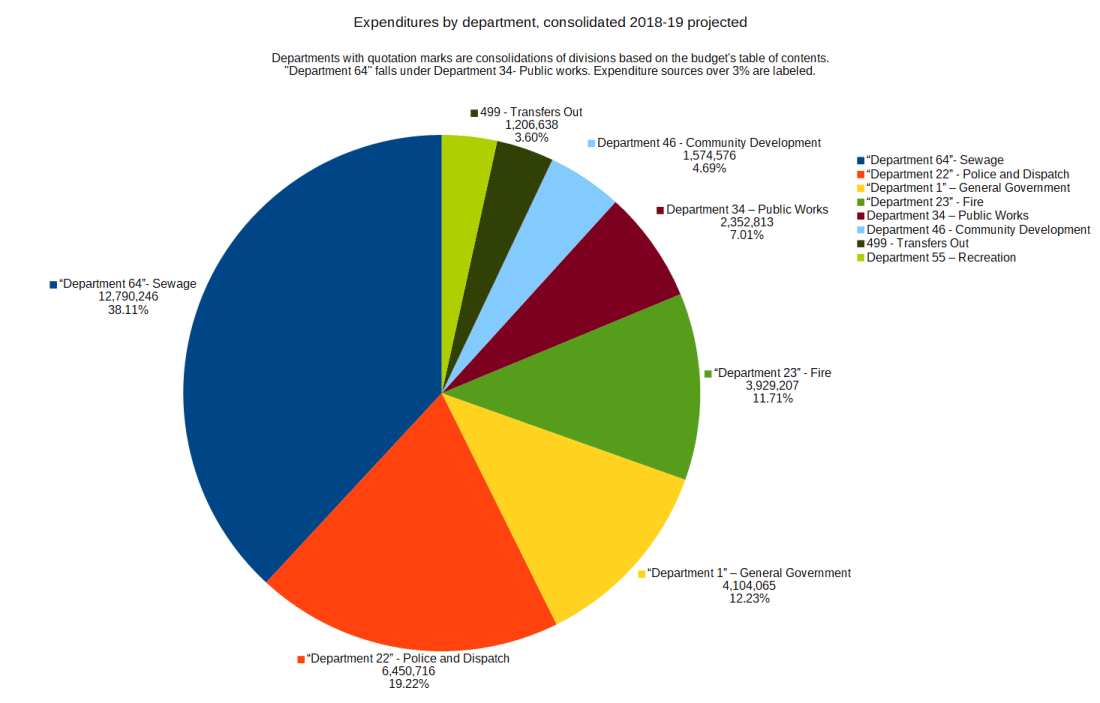
The sewer plant rebuild has cost and will continue to cost the city in the future a substantial amount- by my calculations, $10,404,995 of Public Work’s $15,672,834 expenditure budget is going purely to the sewer plant rebuild alone, with another $2,385,251 going to collections. That leaves $2,352,813 as Public Work’s non-Sewer budget. However, the city also gets significant bound revenue to offset that cost, from Hercules in the form of reimbursements and from sewer customers in wastewater treatment charges.

Because the 2006 and 2014 sales taxes are not included in the general fund, the amount the city relies on sales tax revenue isn’t immediately clear. If you just look at the general fund revenues, sales tax looks like 25% of the city’s revenue. But if you combine all the city’s revenue sources, sales tax goes up to 40% of the city’s unbound revenue. This is a risk when there’s an economic downturn.

The city’s 5-year projection predicts sales tax revenue will remain flat next year and the year after, when the city predicts there will be a recession (B 10-11). I think that might be overly optimistic- when the big box stores shut down, as Toys R Us and OSH already have, they aren’t necessarily going to be replaced by sources of equivalent sales tax value. Furthermore, in a recession discretionary spending tends to fall- I would expect a drop in sales tax value, not a slight increase.

I think the city needs to seek out new revenue sources, as the city itself notes in its Financial Policies:

i. The City will strive to maintain a diversified and stable revenue base that is not overly dependent on any land use, major taxpayer, revenue type, restricted revenue, inelastic revenue, or external revenue.

(A-9). Right now, I think the city is overly dependent on sales tax revenue, and is therefore at risk if and when a recession happens or if the big box stores keep on going out of business.

Pinole Budget Graphs

After several weeks of conversion and calculation, I present Pinole’s budget in spreadsheet form, along with associated graphs! Feel free to use this spreadsheet or the graphs so long as you grant credit to city staff for creating the budget and me for turning it into a spreadsheet. Before I go into the graphs, I’d like to note that the Sewer Treatment Plant rebuild falls under Public Works, and accounts for the vast majority of Pinole’s bound income and a majority of Public Work’s expenses.

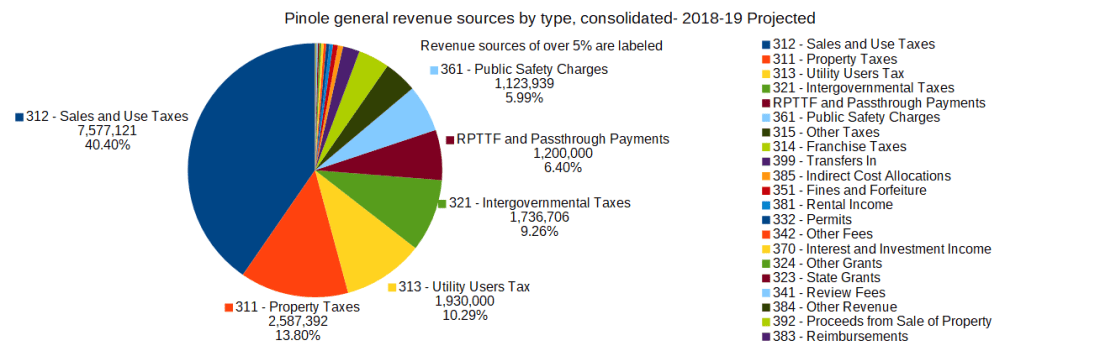
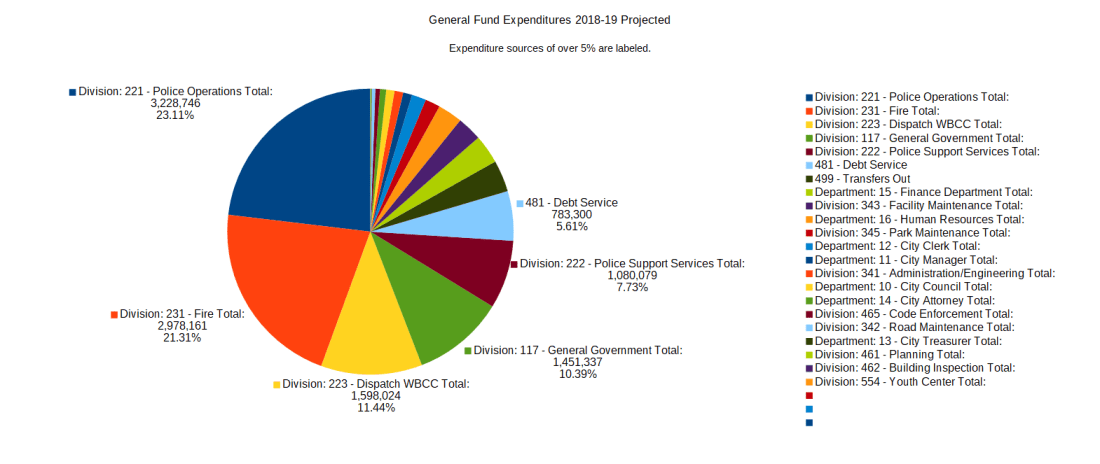
I will begin with graphs from the general fund info, but these graphs are incomplete. There are significant bound and unbound revenue sources as well as expenditure sources outside of the general fund, and my graphs accounting for all the funds follow the general fund charts below. First, pie charts of Pinole’s general fund revenue and expenditures for 2018-19 projected.

Pinole General Fund Revenue Sources Pie Graph

General Fund expenditures 2018-19 projected

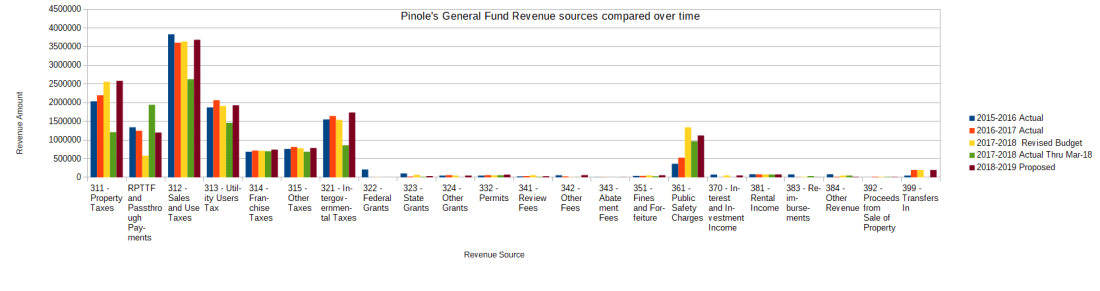
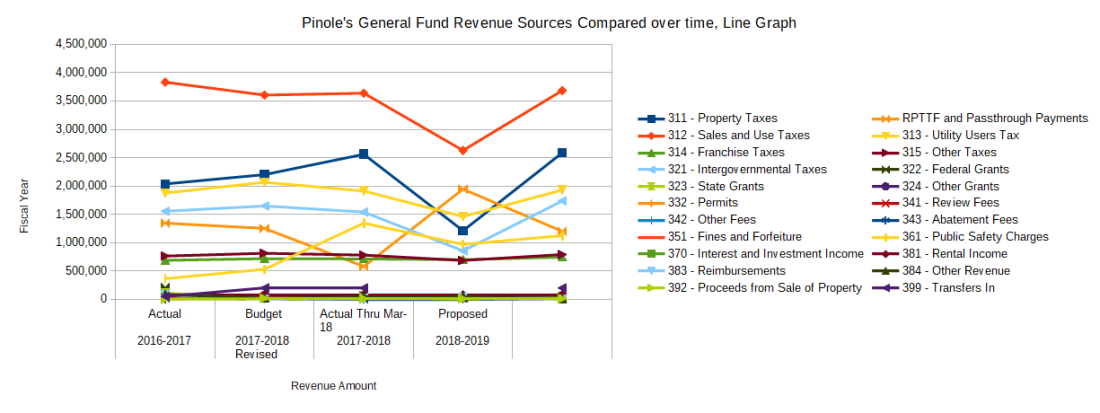
Then we move on to a comparison of general fund revenue sources over time in bar and line chart forms.

Pinole's General Fund Revenue Sources compared over time, Bar Graph

Pinole's General Fund Revenue Sources compared over time, Line Graph

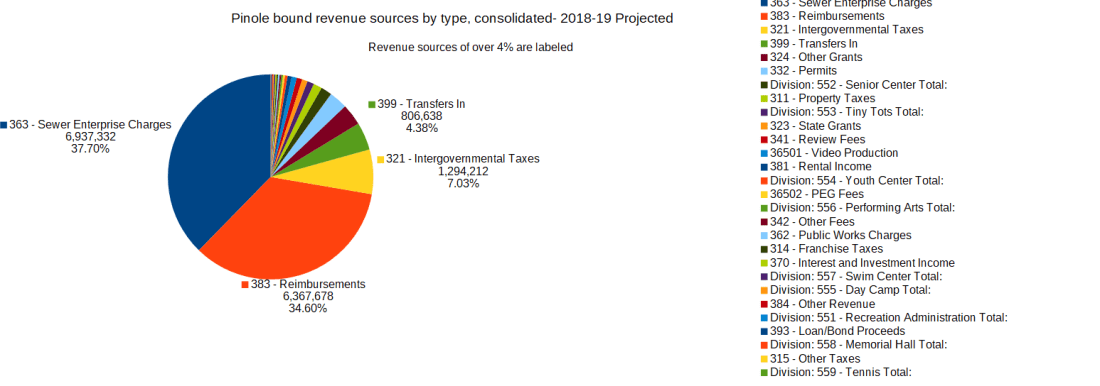
However, there are significant revenue and expenditure sources outside of the general fund. Therefore, we next have general and bound revenue for Pinole 2018-19 in pie graphs, followed by expenditures by department. Note that Sales and Use Taxes make up a full 40% of the city’s anticipated unbound revenue, and the Utility Users Tax makes up another 10%. Bound revenue is overwhelmingly (70%) linked to the sewer plant rebuild.

Pinole's General Revenue sources by type, consolidated 2018-19

Pinole's Bound Revenue sources by type, consolidated- 2018-19

Pinole's expenditures by department, 2018-19

The sewer plant rebuild is noted in its own category, but it belongs under Public Works. As noted in the graph, departments with quotation marks are made from divisions in the budget based on the table of content’s structuring.


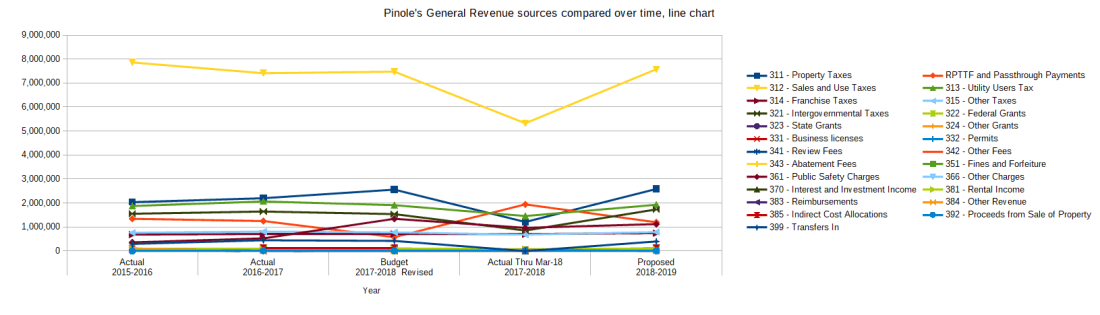
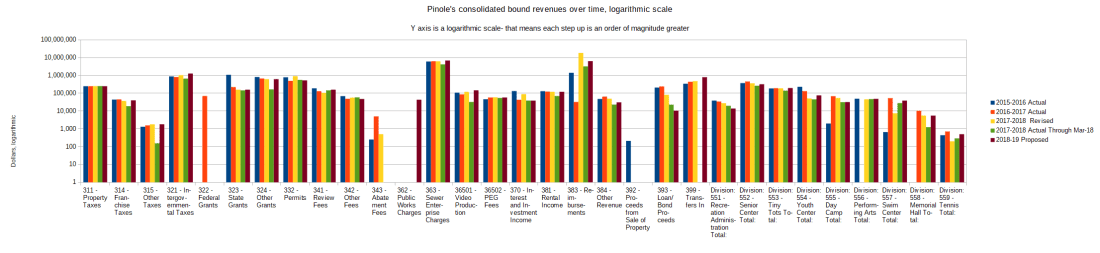
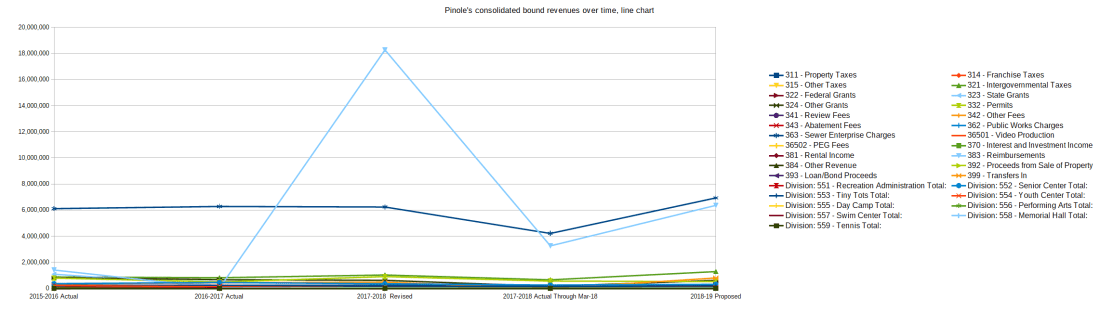
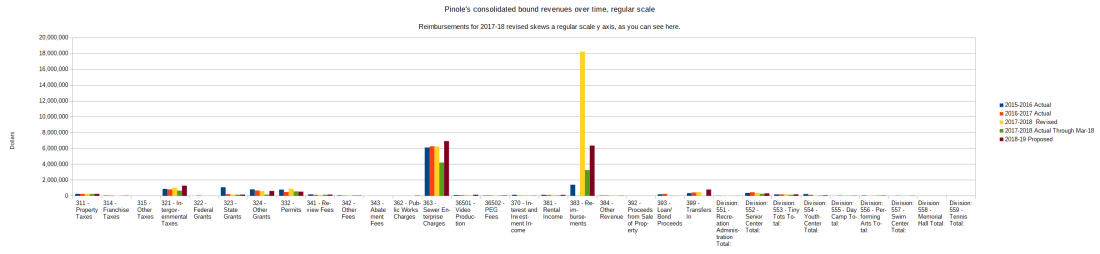
Finally, we have a comparison of overall revenue sources across time, general and bound in bar and line graphs. Due to the 18,277,900 dollar reimbursement in 2017-18 revised (see page B-1), the bound revenue bar graph is provided in logarithmic form, as that amount is a sufficient outlier to make a normal bar graph much less useful.

Pinole's General Revenue sources over time, bar graph

Pinole's General Revenue sources over time, line graph

Pinole's consolidated bound revenues over time, logarithmic bar chart

Pinole's consolidated bound revenues over time, line chart

Pinole's consolidated bound revenues over time, bar chart

Pinole’s Government Structure

The first step to reconnecting the government with the community is for people to know who all is in the government and what they do. Pinole is a general law city under a council-manager system, which means that there are certain laws we cannot make, and that city staff implement policy, not the council. I talked with the city manager at some length about what city staff did, and she gave me the following information. Items [in brackets] are my commentary.

First, some hyperlinks in case you want to look at one department in particular-

City Government overall

At the top level, there’s the City Manager and Assistant City Manager. Michelle Fitzer, the City Manager is in charge of all city departments, writes staff reports, letters and analysis. She also writes the city council’s agenda and any associated attachments. She also handles inter-agency cooperation, as well as sitting on the municipal pooling authority as Pinole’s representative. Finally, she does other projects as necessary.

Hector De La Rosa, the Assistant City Manager, is the head of HR, Recreation, and Pinole Cable TV. In addition, he’s in charge of the close out of Pinole’s Redevelopment Agency.

The City Attorney is under contract with Meyers/Nave, since the city does not need an attorney full-time and the expenses associated with having one at full-time rates and benefits would be substantial. This also allows for a broader range of knowledge than any one attorney might possess. The current attorney they have assigned to us is Eric Casher.

Fire Department

Scott Kouns is the head of the Fire Department. [There is one fire station in Pinole- there used to be two, but apparently the second station was built without an adequate funding stream to keep it open. It would cost the city 2.8 million dollars annually to keep the Pinole Valley Fire Station open.]

Police Department

Neil Gang is the head of the Police Department. Pinole has 38 police officers (the full staffing allocation), covering 3 beats- the Fitzgerald shopping mall complex, Pinole Valley, and the rest of Pinole.

Development Services

Tamara Miller is the Development Services Director and City Engineer. As such, she oversees planning, building, engineering, public works and the water pollution control plant. Ordinarily, the city would have building inspectors, but Pinole cannot afford to pay building inspectors at market rates, and so cannot find any.

Winston Rhodes is the planning manager, and oversees planning, building and code enforcement. There are 2 contractors doing code enforcement work as well.

Finance

Andrea Miller is the Finance Director. She oversees payroll, accounts payable and receivables (though the city does not have many accounts receivable). She also does bank reconciliations and deposits, along with reconciling cash payments received by the city. Finally, she also handles audits of Measure S and grants that the city has received. The Finance department also has 2 accounting specialists at 19 hours per week (just under the benefits threshold of 20 hrs/week).

Public Works

Public Works also has a public works specialist, for dealing with encroachment permits for work in public right of way, acting as a site inspector and doing project management. Public works is in charge of the city’s maintenance yard and the equipment there. They are also in charge of building maintenance, limited pothole repair (depending on the amount allocated in the city’s Capital Improvement Plan), sewer infrastructure, and infrastructure more broadly. Landscape maintenance is contracted out. Finally, public works does emergency response to accident cleanup and floods.

Water Pollution Control Plant

Ron Tobey is the plant manager. The plant treats and discharges waste water (sewage) according to state permits. This does not include stormwater- that goes to a completely different system. Or at least, it should. But because Pinole’s sewer infrastructure is in need of repair (with some being done in the current CIP), stormwater can infiltrate the sewer lines and increase Pinole’s wastewater costs. Pinole owns the land that the water treatment plant is on, and 50% of the plant itself. Hercules owns the other half of the plant. The cities share operating costs for the plant based on usage- so when stormwater from Pinole goes to the plant, it increases Pinole’s costs.

Pinole TV

Pinole runs its own cable TV channel, which has 2 full time employees and funding allocated for part time staff. The channel records and broadcasts council, planning commission and water pollution plant committee (and subcommittee) meetings. They also provide those services to Benecia, West Contra Costa Unified School District (WCCUSD), and WestCAT (West county transit- buses and dial-a-ride) under contract, and can gain revenue from those contracts.

Recreation

Recreation has an overall manager, whose name I do not know. There’s three sub-departments under Recreation- the Senior Center, the Youth Center, and Tiny Tots. Each has its own coordinator, with all other workers being part-time. There’s also the Swim Center, which is contracted out to the Pinole Seals. They have been doing well so far. Tiny Tots creates sufficient revenue to cover its expenses. The Senior Center does not. [There are several reasons for this- the center shifted to an online membership system, which many of their members did not transition into, the center has been maintained but not improved (as per the city’s silo system for department funding), and the city’s funding of the Senior Center is limited. As a result, the ambience of the senior center can be unpleasant (ref Council Member Long, City Council Meeting 8/21/18).]

The Youth Center was revamped recently to shift from an after-school focus to enrichment classes. There have not been many signups yet.

My Commitments

I have agreed to abide by the city of Pinole’s Local Campaign Contribution Limits, and California’s Code of Fair Campaign Practices.

The Local Campaign Contribution Limits caps the amount I can raise from any single person at $500 dollars, from any political committee at $1000 dollars, and the overall amount I can raise at $12,000 dollars.

The Code of Fair Campaign Practices is worth quoting in full. It says-

CODE OF FAIR CAMPAIGN PRACTICES

There are basic principles of decency, honesty, and fair play which every candidate for public office in the State of California has a moral obligation to observe and uphold in order that, after vigorously contested but fairly conducted campaigns, our citizens may exercise their constitutional right to a free and untrammeled choice and the will of the people may be fully and clearly expressed on the issues.

THEREFORE:

(1) I SHALL CONDUCT my campaign openly and publicly, discussing the issues as I see them, presenting my record and policies with sincerity and frankness, and criticizing without fear or favor the record and policies of my opponents or political parties that merit this criticism.

(2) I SHALL NOT USE OR PERMIT the use of character defamation, whispering campaigns, libel, slander, or scurrilous attacks on any candidate or his or her personal or family life.

(3) I SHALL NOT USE OR PERMIT any appeal to negative prejudice based on a candidate’s actual or perceived race, religious creed, color, national origin, ancestry, physical disability, mental disability, medical condition, marital status, age, sexual orientation, sex, including gender identity, or any other characteristic set forth in Section 12940 of the Government Code, or association with another person who has any of the actual or perceived characteristics set forth in Section 12940 of the Government Code.

(4) I SHALL NOT USE OR PERMIT any dishonest or unethical practice that tends to corrupt or undermine our American system of free elections, or that hampers or prevents the full and free expression of the will of the voters including acts intended to hinder or prevent any eligible person from registering to vote, enrolling to vote, or voting.

(5) I SHALL NOT coerce election help or campaign contributions for myself or for any other candidate from my employees.

(6) I SHALL IMMEDIATELY AND PUBLICLY REPUDIATE support deriving from any individual or group that resorts, on behalf of my candidacy or in opposition to that of my opponent, to the methods and tactics that I condemn. I shall accept responsibility to take firm action against any subordinate who violates any provision of this code or the laws governing elections.

(7) I SHALL DEFEND AND UPHOLD the right of every qualified American voter to full and equal participation in the electoral process.

I, the undersigned, candidate for election to public office in the State of California or treasurer or chairperson of a committee making any independent expenditures, hereby voluntarily endorse, subscribe to, and solemnly pledge myself to conduct my campaign in accordance with the above principles and practices.

That means I will be honest about what I see as the issues facing Pinole, that I will criticize policies that deserve criticism without fear or favor. I will not use attacks on other candidate’s character by any means, and I will repudiate any support or endorsement I have received from anyone else if they do so. I will not appeal to prejudice or bigotry (which I would never do in any case- I abhor bigotry of all kinds). I will not undertake any dishonest or unethical practice to corrupt the elections or stop people from voting (unlike many actions of the Republican party over the last decade). I won’t coerce contributions or help from anyone, not just my employees (since I don’t have any). I will repudiate any support I have received from a person or group if they do any of those things. And I will fight to make sure that everyone who is allowed to vote can vote.

My Qualifications

I think a good city councilor above all else needs to be able to Listen. If you can’t listen to your constituents, you can’t understand their concerns. If you can’t listen to your fellow council-members, you don’t know what their goals and concerns are, or what their objections might be to your goals and concerns. If there’s any one thing I’ve learned from working as a home healthcare aide, it’s how to listen. Listening isn’t just about hearing the words that are said, though that’s definitely important. Body language, tone, which words in particular are used, and what is not said are all important parts of listening as well.

Second, you need to be Persuasive. You need to be able to persuade the electorate to be elected at all, of course, but you also need to be able to persuade your fellow Council-members and anyone you’re working with on the various boards you’re assigned to. If you can’t persuade people, you can be a great listener and problem solver and have exactly the right vision- but you won’t be able to use those strengths to accomplish your vision. It’s difficult to prove that you’re persuasive in the abstract, so I’ll refer to my speech on the Library at the May 15th meeting (video, go to 1:09 for the core of the argument).

Third, you need to be a good problem solver. This is relatively broad- you need to be open-minded, to have access to the broadest possible range of ideas, be good at analyzing things, so you can get rid of the ideas that don’t work, and be able to implement your chosen solution. You also need to be able to learn things quickly. Some of these attributes I’ll only be able to demonstrate over time, through actions- but I’ve already demonstrated them in one instance. I went to the University of Chicago and graduated with a BA in Political Science with general honors. I did that by learning ideas from a broad range of sources- ancient writers, modern ones, activists, and through my work in a community non-profit; synthesizing them together in various different ways as the situation required, and implementing my understanding of those ideas through writing and action.

Fourth, you need to be Dedicated. I have demonstrated and will continue to demonstrate this dedication by attending city council meetings, and urge my fellow candidates to join me. Being on the city council is a significant ongoing time requirement. You are, at a minimum going to be spending ten hours a month at city council meetings, and at least that much again on various committees and regional boards. Based on my discussions with city staff, being on the City Council, if you don’t interact with the community at all outside of meetings, is a 40-hour workweek at below minimum wage levels. If elected, my work as a home healthcare aide allows me schedule flexibility to meet the needs of the city, above and beyond the minimum requirement. As I’ve stated in my platform, I intend to do outreach on social media and via flyers to make the city’s information more accessible to the general public- both before and after the election.

Finally, you need to have a vision. Your job as a city council member isn’t to do nuts and bolts implementation of city policy- that’s the city staff’s job. Your job is to provide direction. My vision for Pinole is a city where there’s a thriving community that is engaged with its government, which in turn provides the services and spaces to help the community thrive.

About Me

I’ve been living in Pinole since 2011, helping with my mother’s daylily business for all of that time and working as a licensed home healthcare aide since 2016. For a while, I was disengaged from politics- but Bernie Sanders’ campaign in 2016 got me back into political action. I joined the Pinole Progressive Alliance in 2017, and have been working with them to try and get the library running at full hours. After going to all but one of the city council meetings since May, I saw that there was a marked disconnect between Pinole’s city government and the community, that there was significant division within the community, and that there were not really any community gathering spaces for working-age adults in Pinole. After talking with city staff, I realized the long-term threats to Pinole’s financial stability. Without better engagement and communication between city government and the community, Pinole will decline. But working together, we can renew Pinole.